
Last updated September 20, 2026
Free on-site gate assessment - hinges, posts, and your LiftMaster or Nice gate operator checked before anything is quoted
The assessment is free and the quote is the invoice.


 Before
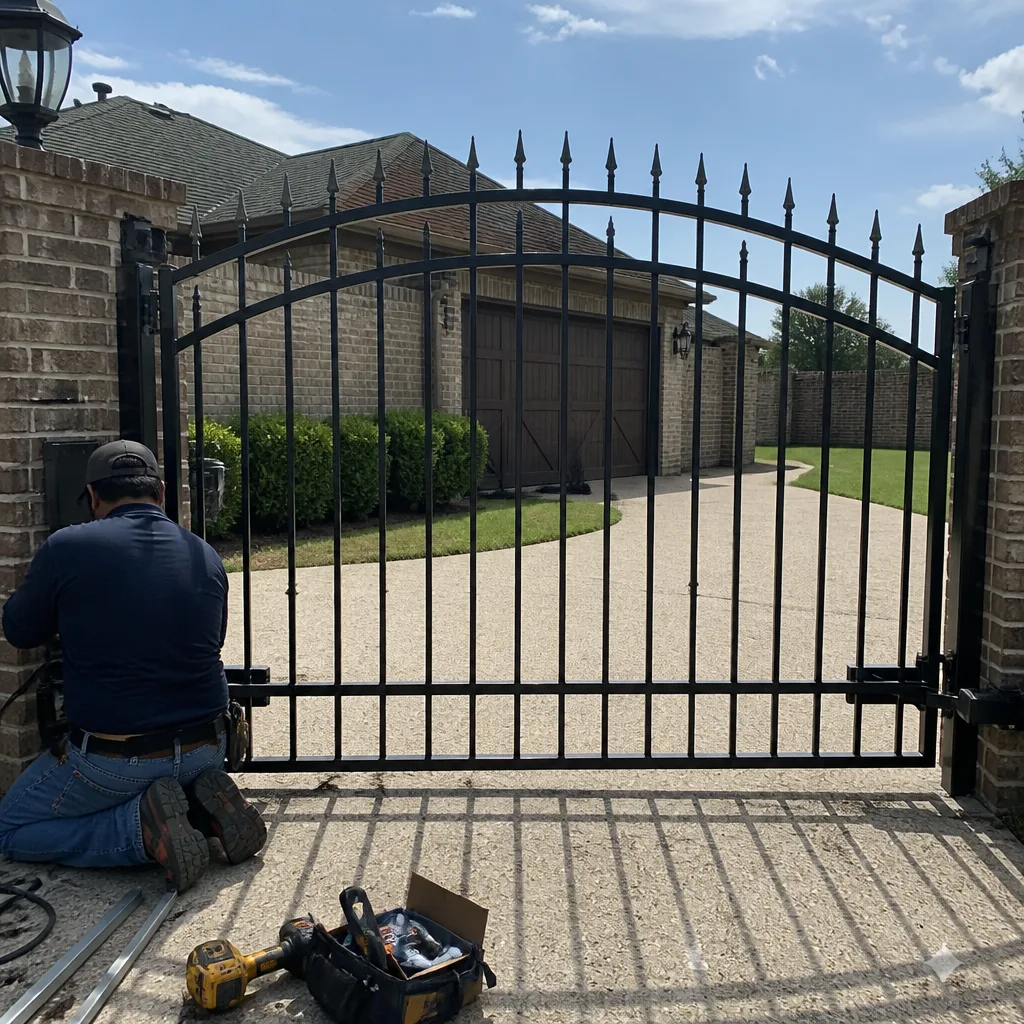 After
After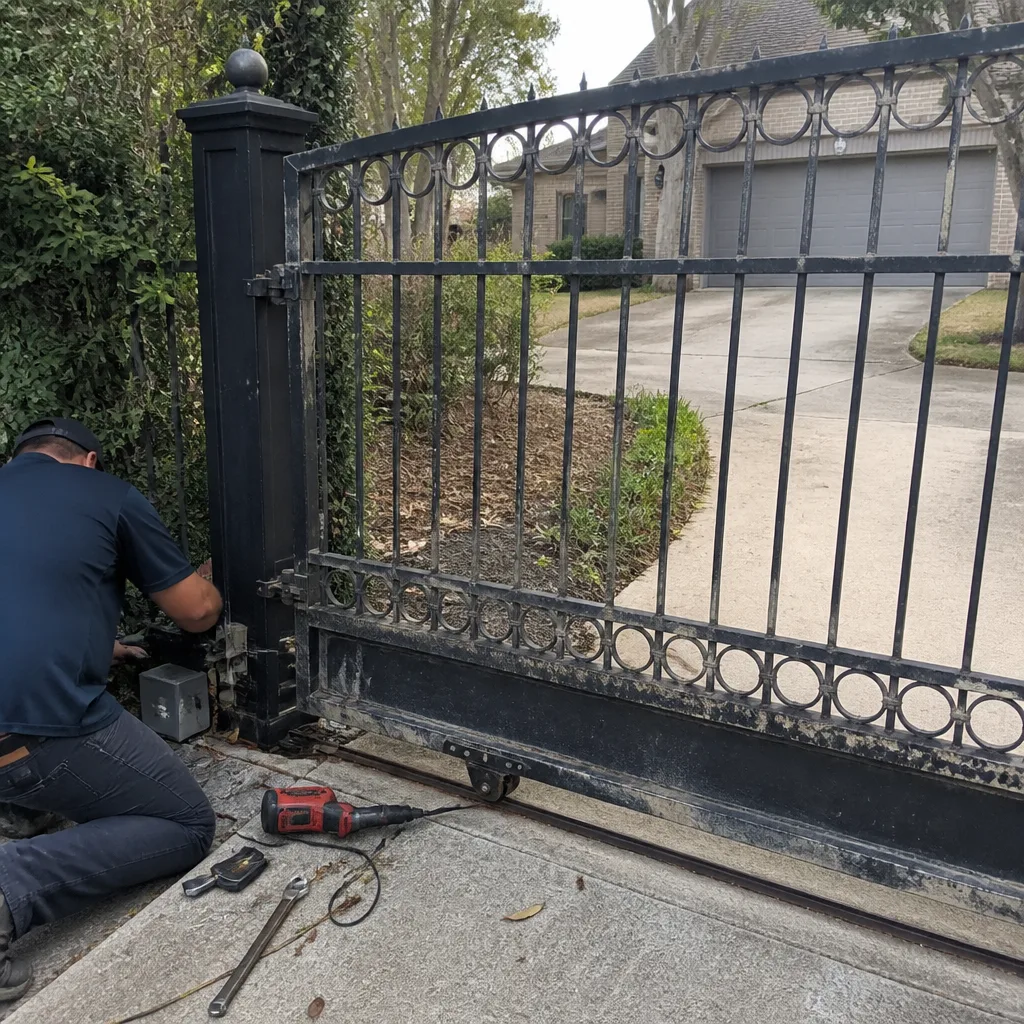 Before
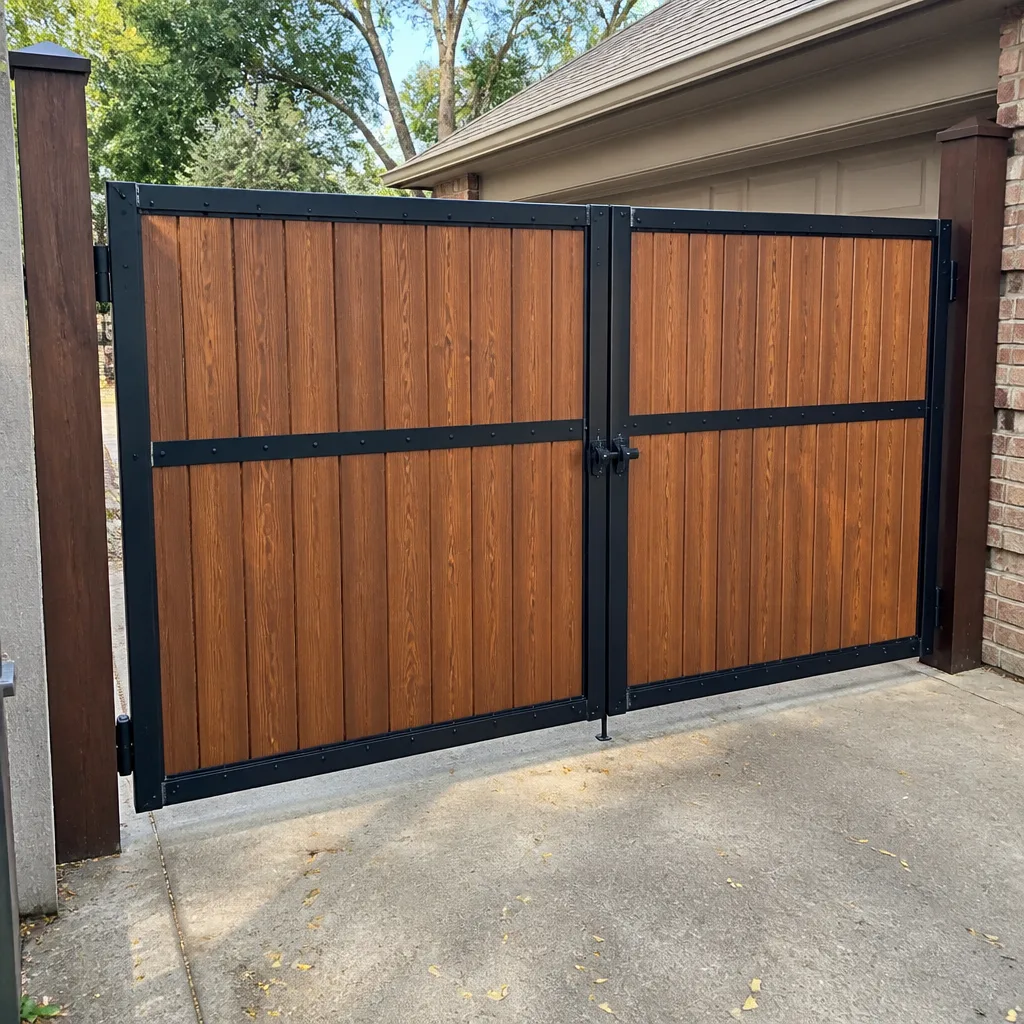 After
After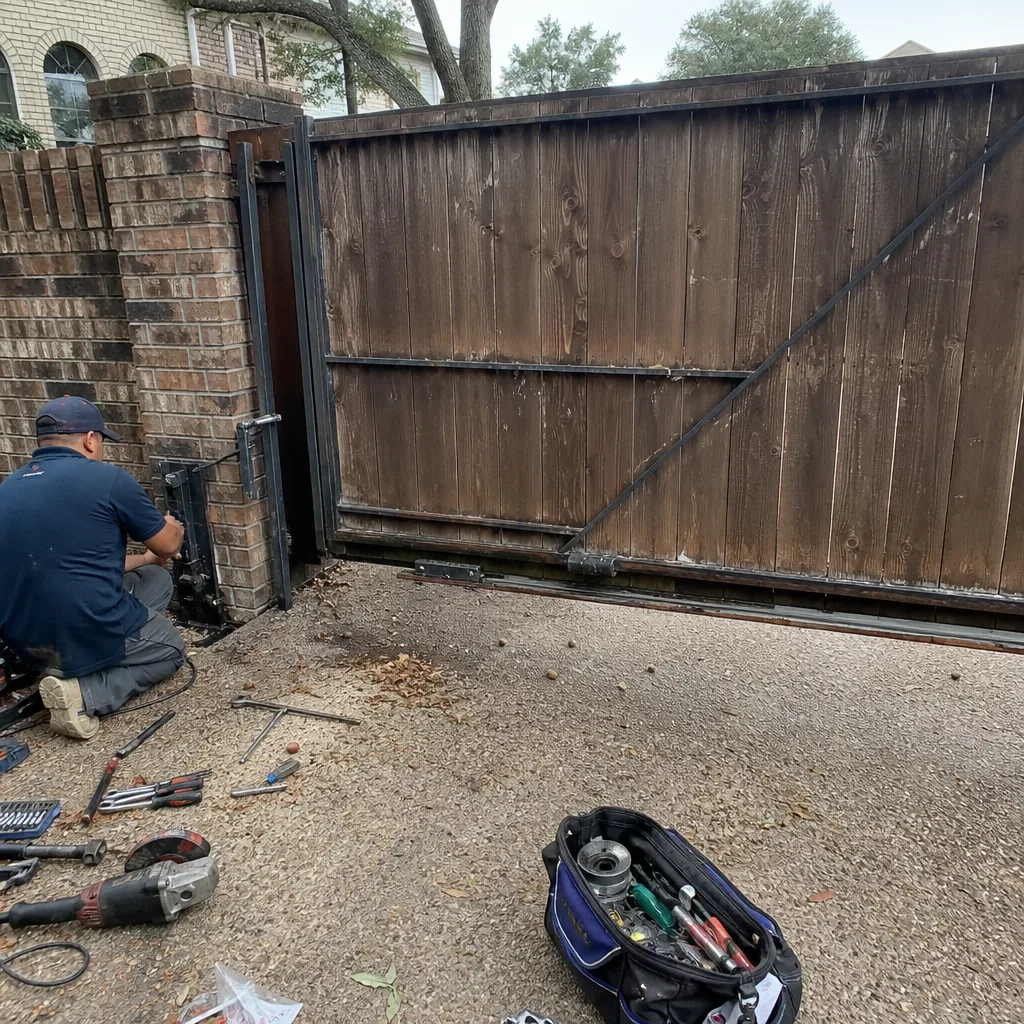 Before
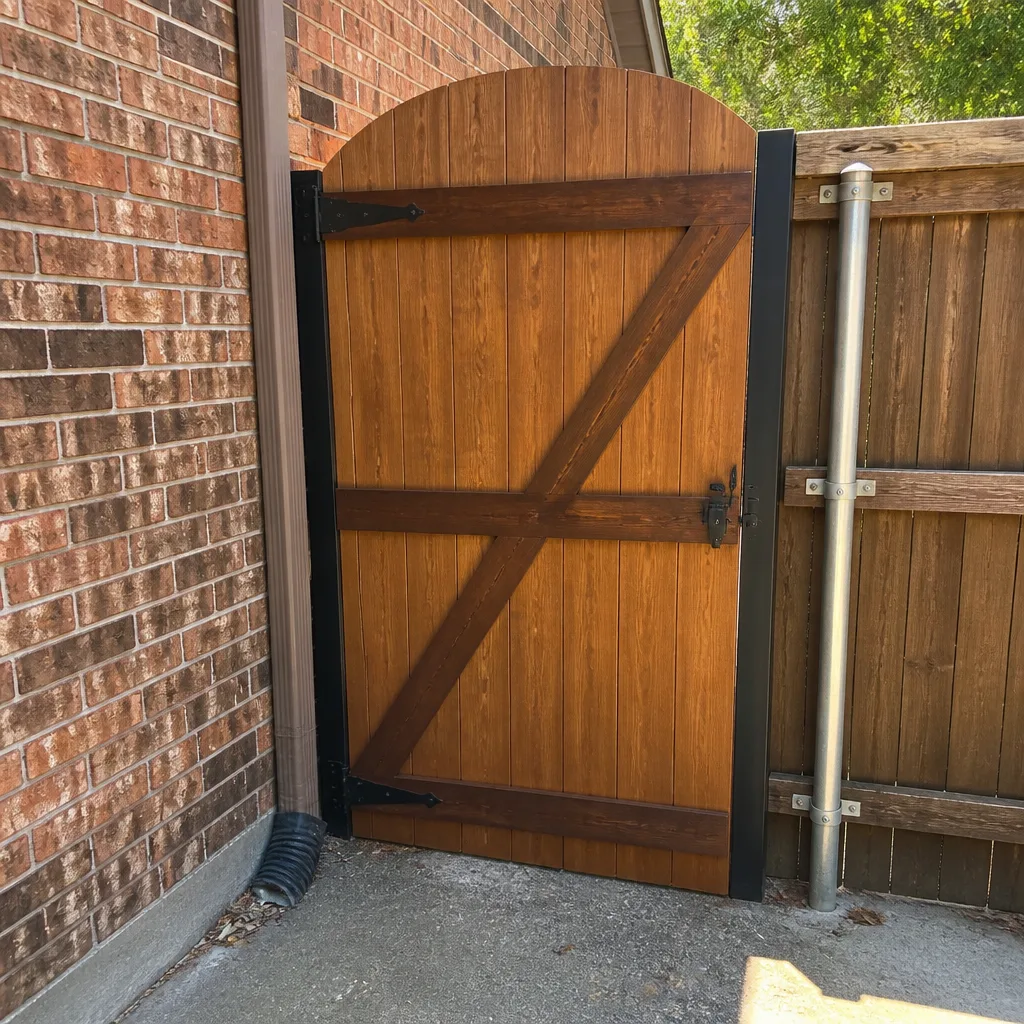 After
AfterGate Repair Warning Signs: A Bedford Homeowner’s Reference Guide
The most expensive gate repairs start as a two-second hesitation that the homeowner decided to watch for another week. The hesitation is the warning; everything after it is consequence. In Bedford, where driveway gates live through clay-heavy soil shifts, hard sun, and the occasional ice morning, those two seconds show up faster than they do elsewhere. This guide matches the exact sound, movement, or silence your gate makes to the component that is failing, so you know what to photograph, what to try safely, and when the right move is a phone call instead of a guess.
Quick Answer
Most gate repair warning signs in Bedford fall into three groups: mechanical warnings you can see and hear (grinding, scraping, leaning, rust), electrical warnings you can test (hesitation, partial travel, dead keypad), and logic warnings where the gate moves but acts wrong (reversing mid-cycle, failing open, failing locked). The urgent ones are a gate that reverses onto a car, drags on the ground, or locks you inside; those need Gate Repair services from a same-day Bedford gate technician and are not DIY situations.
Table of Contents
- The Bedford Symptom Matrix: Sound, Movement, and Cause
- Mechanical Warning vs. Logic Warning: Why the Distinction Decides the Next Step
- Bedford-Specific Environmental Warnings: Rust, Lean, and UV
- Fail-Safe vs. Fail-Locked: What Your Gate Does When Power Dies
- The Hesitation: When a Pause Is a Warning
- How to Photograph and Describe a Gate Warning So the Diagnostic Takes Five Minutes
- Keypad, Remote, and Intercom Warnings: The Signals Nobody Checks
- Motor Strain and Limit Switch Drift: The Two Most Misdiagnosed Warnings
- Common Mistakes to Avoid
- When to Call a Professional
- Frequently Asked Questions
- The Bottom Line
BeforeAfterThe Bedford Symptom Matrix: Sound, Movement, and Cause
The way to turn a warning sign into a repair is to match the specific behavior to the specific failure mode. A gate that is “making a noise” is not enough information. A gate that “grinds on the first open after a cold night and smooths out after three cycles” is nearly enough to order parts. Below is the working matrix we use on diagnostic calls in Bedford. Each row is a symptom, the likely causes, and whether the inspection is safe for a homeowner to attempt.
Symptom: Gate hesitates before moving, then runs fine
- Most likely: Stiff hinge or wheel bearing creating initial resistance; the motor’s start capacitor is weak and taking longer to generate torque.
- Second possibility: The gate is slightly out of plumb after soil movement, so the motor fights the geometry for the first few inches of travel.
- Third possibility: Limit switch setting has drifted past the physical stop, so the motor ramps against the end stop before the control board registers the position.
- DIY-safe to inspect: Yes, for the hinge and wheel check. No for anything involving the capacitor or limit switch. A capacitor holds electrical charge even with power off.
Symptom: Gate reverses direction mid-travel for no visible reason
- Most likely: Misaligned photo-eye safety beam or a failing photo-eye wire splice.
- Second possibility: Inherent obstruction detection is triggering due to increased rolling resistance from a partially seized wheel or a bent track section.
- Third possibility: Control board relay is chattering from a voltage drop, often a tired transformer or a corroded wire nut in the junction box.
- DIY-safe to inspect: You can clean the photo-eye lenses and check for overgrown ivy or a leaning hedge blocking the beam. Do not open the control board enclosure if the gate is live.
Symptom: Grinding or screeching during travel
- Most likely: Dry or failed wheel bearings on a rolling gate, or a swing gate hinge that has lost its lubrication and is wearing metal on metal.
- Second possibility: A gearbox on the motor itself is low on oil or has a chipped tooth.
- Third possibility: The rack or track has accumulated gravel and grit from the driveway, and the wheel is crushing it as it travels.
- DIY-safe to inspect: Visually check the track for debris and listen to whether the sound comes from the wheel carriage or the motor housing. Lubricating a hinge is fine. Opening a motor gearbox is not.
Symptom: Gate starts moving, stops after a foot, and reverses
- Most likely: One bad battery in a solar or dual-battery setup causing a voltage sag under load, which the control board interprets as an obstruction.
- Second possibility: A wheel has flat-spotted from sitting, and the initial bump reads as an impact.
- Third possibility: The current-sensing circuit on the board is set too sensitively for the gate’s weight after a modification, like adding a screen panel or decorative finial.
- DIY-safe to inspect: Battery voltage check with a multimeter if you own one. No multimeter, no battery swap; call a tech.
Symptom: Gate opens, but will not close
- Most likely: The close limit switch is failed or misread, so the board does not know the gate reached the open position and refuses the close command.
- Second possibility: A photo-eye is sending a constant “obstruction present” signal due to water inside the eye housing.
- Third possibility: A loop detector under the driveway is stuck in the “vehicle present” state, holding the gate open by design.
- DIY-safe to inspect: Check the photo-eye for visible moisture and condensation. Loop detector diagnostics require a probe. Leave it.
Symptom: Gate operator hums but gate does not move
- Most likely: Failed or low start capacitor in the motor.
- Second possibility: Gearbox is seized or the drive chain has snapped inside the operator housing.
- Third possibility: A motor-starter contactor has welded or burned a contact, leaving one phase open.
- DIY-safe to inspect: None of this is safe to inspect. A humming motor is a live motor. Kill the breaker and call a Bedford gate technician.
If you learn nothing else from the matrix, learn this: hesitation, grinding, and reversal are each tied to a different repair path. Diagnosing the right one on the first visit is what separates a $200 bearing job from a $1,400 control board replacement that would not have fixed the symptom.
Mechanical Warning vs. Logic Warning: Why the Distinction Decides the Next Step
Every gate warning sign is either a mechanical problem (something is bent, rusted, worn, heavy, or stuck) or a logic problem (something is sending a signal the board interprets incorrectly). The repair approach, the diagnosis tools, and the technician you need are different for each, and misclassification is the most common reason Bedford gate repairs take two visits instead of one.
Mechanical warnings look and feel physical
- The gate scrapes the concrete or drags through gravel.
- You can see a visible lean in the post or a sag at the latch end.
- The gate is harder to push manually than it was last year.
- Rust is flaking at the hinge base or the wheel carrier is sitting at an angle.
- The gate bounces when it stops rather than stopping clean.
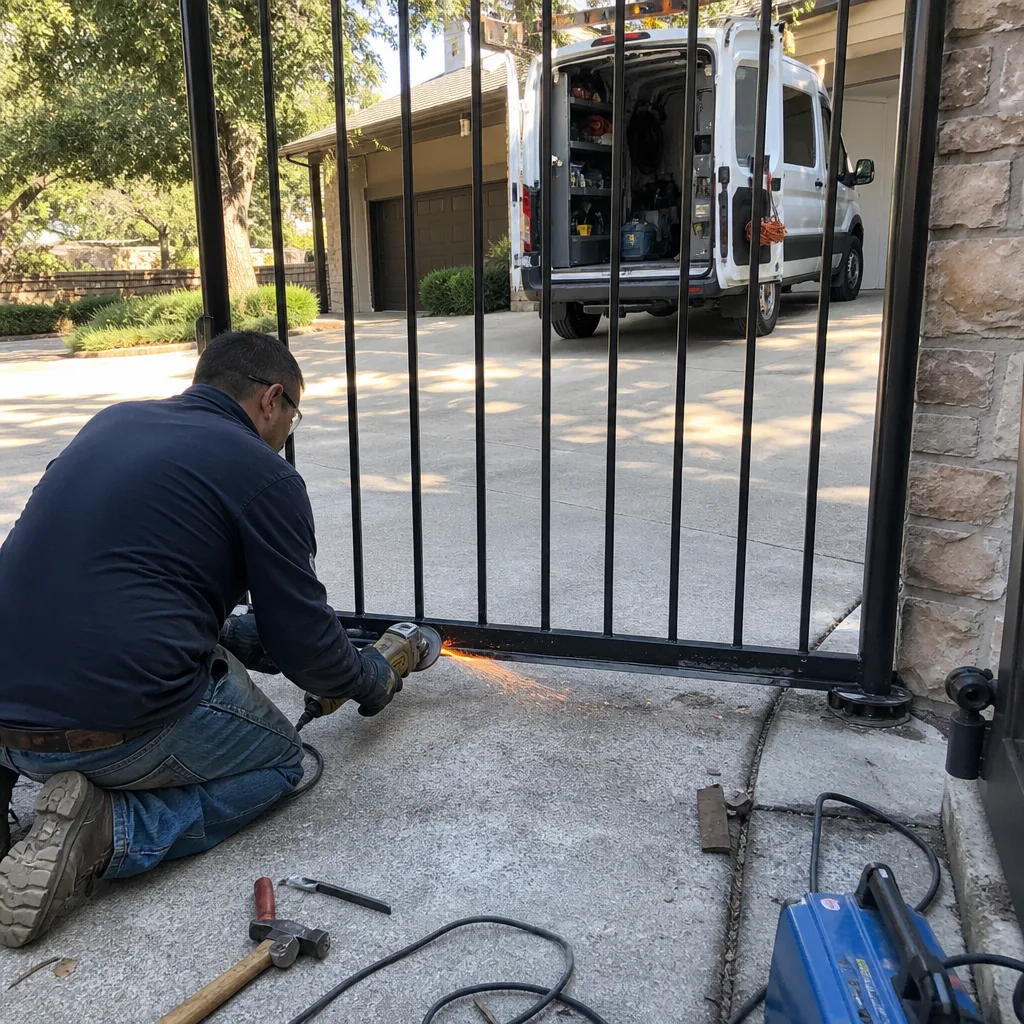
These warnings almost always involve geometry, foundation movement, weight distribution, or wear. They are diagnosed with levels, calipers, pull tests, and inspection cameras. They are repaired with wrenches and welding equipment, not with a laptop. A Bedford gate that has drifted out of level after a wet spring usually needs a mechanical correction, not a new control board.
Logic warnings look electrical and behavioral
- The gate opens when no one is there or refuses to close without a visible obstruction.
- The keypad works sometimes and not other times, with no weather pattern.
- The gate reverses at the same point every cycle, even when the path is clear.
- The operator displays a diagnostic LED flash pattern, but the gate still moves.
- The remote works from 20 feet away but not from the driver’s side window at the approach angle.
Logic warnings are the control board, the limit switches, the photo-eye, the loop detector, the receiver, the transformer, or the wiring between them. They are diagnosed with a meter and the board’s diagnostic sequence. They are repaired at the component level or by replacing a specific board. DoorKing and Ghost Controls boards, for example, surface error codes differently, and a tech who knows both skips the guesswork. Gate motor and opener diagnostics in Bedford almost always reveal a logic warning behind repeated “mystery” reversal calls.
The home test that matters: disconnect the operator arm or chain and push the gate by hand. If the gate moves smoothly and quietly with no power, the problem is logic or electrical. If the gate fights you manually, the warning is mechanical. That one test takes thirty seconds and saves a diagnostic hour.
Bedford-Specific Environmental Warnings: Rust, Lean, and UV
Bedford’s climate and soil do specific, predictable things to gate hardware. Clay soil expands and contracts with moisture, causing ground-level post movement that a gate in Rockport or Lubbock would not see as quickly. Summer heat above 100 degrees bakes the plastic components. The occasional hard freeze will crack what the heat started. These are the environmental warnings a Bedford homeowner should recognize by sight.
Rust at the hinge base on a swing gate
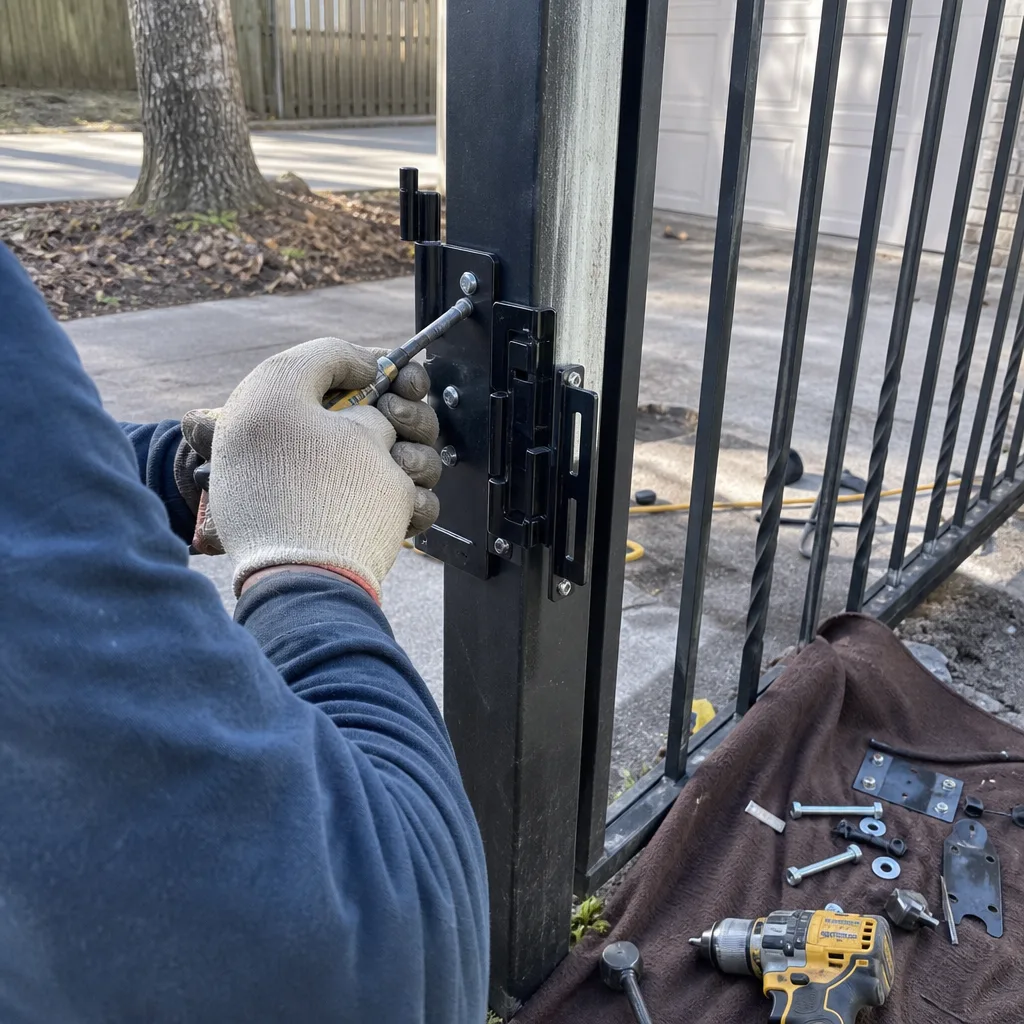
Bedford’s clay soil holds moisture against buried steel and against the bottom hinge. The rust you see at the hinge base on the street side is the top of a longer corrosion story that runs down the post, below grade. The warning is not the surface rust; it is the thinning of the hinge weld behind it. A gate that weighs 500 pounds is hanging on that hinge. In Bedford, a hinge rusted through at the base fails as a drop, not a scrape. If you can see flaking rust below the hinge pin, the hinge has already lost structural margin. That is not a lubrication call. That is a replacement call with a weight rating that matches the gate’s actual load.
Post lean on the street-side corner
The street-side post carries the load of the gate’s full travel arc and receives the most rain run-off from the driveway slope. Clay soil movement will inch that post over. You spot it two ways: a gap opening between the post cap and the concrete footer, or a visible shift in the gap between the gate and the post when the gate is closed. A leaning post in Bedford is a progressive problem. Each wet cycle moves it a few millimeters more. By the time the gate visibly drags, the post has already traveled far enough that the repair is a dig-out and reset, not a shim. Early-stage lean is addressed with a concrete sleeve or a deeper footer. Late-stage lean is a full post replacement. The difference in cost is hundreds of dollars. The warning is visible for six to twelve months before the gate drags.
UV cracking on the control box gasket or the remote housing
North Texas sun will crack the rubber gasket around the control box lid on any brand, but it shows up fastest on Mighty Mule and Ghost Controls units that use a lighter compound. Once the gasket cracks, water enters the enclosure during the first sustained rain, and that water will take out a board over months. The visible warning is hairline spider cracks on the gasket material, especially along the hinge side. Replace the gasket when you see the cracks; that is a $15 part sitting in front of a $600 board. If the enclosure collects condensation inside the lens window in the morning, water has already entered. Kill the breaker and call a tech before cycling the gate again.
Bedford yards with heavy clay and automatic irrigation also push up against the control box and photo-eye wire conduit. A weed-eater string can strip the insulation on low-voltage wire in one season. Each of these is a Bedford-specific environmental warning, and each points to a different repair timeline. You can read more about the full repair approach in our Bedford gate repair service guide.
Fail-Safe vs. Fail-Locked: What Your Gate Does When Power Dies
Your gate operator was configured one of two ways during installation: fail-safe, meaning the gate opens or remains open when power is lost, or fail-locked, meaning it stays wherever it is or requires a manual release. Most residential Bedford gates are not fail-safe. They default to whatever position they were in when power dropped. The distinction matters because it changes how urgently you treat certain warnings.
A gate that fails locked can trap a vehicle inside a property with no other exit. It can also prevent emergency access from the street. Bedford homes with a single driveway and no pedestrian gate should consider this carefully. The warning sign is not the power outage; it is the symptom before it: if you have noticed the gate being slow to respond to the remote, or the battery backup has been in place for five years without a replacement, those are the warnings that a future power event will turn into a locked gate. The failure itself is not the surprise. The ignored warning is.
A gate that fails safe presents a different problem: security. If your gate drifts open on a power blip, the operator was configured to fail open, and that is a choice someone made during install. It is not always wrong; it is sometimes code-driven for fire access. But if you did not ask for it and you are treating the gate as a security boundary, that configuration should be revised. The warning sign is the gate being fully open every time you come home after a storm or a flickering-light event. That is not random. That is the operator doing exactly what it was set to do.
Neither configuration is inherently bad. What matters is that the homeowner knows which one applies to their gate. Our technicians in Bedford check this on every visit and document it in the written record. If you do not know the answer, a quick inspection will tell you. Do not wait for a power failure to find out.
The Hesitation: When a Pause Is a Warning
The two-second hesitation between the time you press the remote and the time the gate starts moving is the single most ignored warning in gate systems. Homeowners chalk it up to age, temperature, or a weak remote battery. Sometimes it is the remote. More often, it is the motor’s start capacitor losing the ability to deliver the initial burst of torque, and the hesitation is the sound of the motor struggling to overcome inertia.
Here is what the hesitation typically means, in order of probability, for the Bedford gates we service:
- Weak start capacitor. The capacitor provides the voltage spike that starts the motor spinning. Capacitors degrade with heat and time. A capacitor that is 80 percent dead will still start the gate, but it will pause first, and the pause will get longer over months. This is the classic “it warms up and then works” symptom.
- Hinge or wheel resistance. The first open of the day after a cold Bedford night is harder because grease is stiff and bearings are compressed. The pause is the motor ramping power against extra mechanical load. If the gate smooths out after the first cycle, resistance is the likely cause.
- Control board relay delay. Some boards, especially older FAAC and Elite models, have a built-in soft-start delay. That is a feature, not a failure. The way to tell the difference is that a soft-start delay is consistent, while a capacitor pause grows longer over time and varies with temperature.
The hesitation is a warning because a capacitor does not fail all at once. It announces itself. If you catch it during the announcement, the repair is a $60 to $150 component and about an hour of labor. If you wait until the gate stops moving entirely, the failed capacitor can take the control board’s relay with it, and the repair becomes far more expensive. In our experience, Bedford homeowners who call at the first hesitation save an average of $400 versus those who wait for full failure.
How to Photograph and Describe a Gate Warning So the Diagnostic Takes Five Minutes
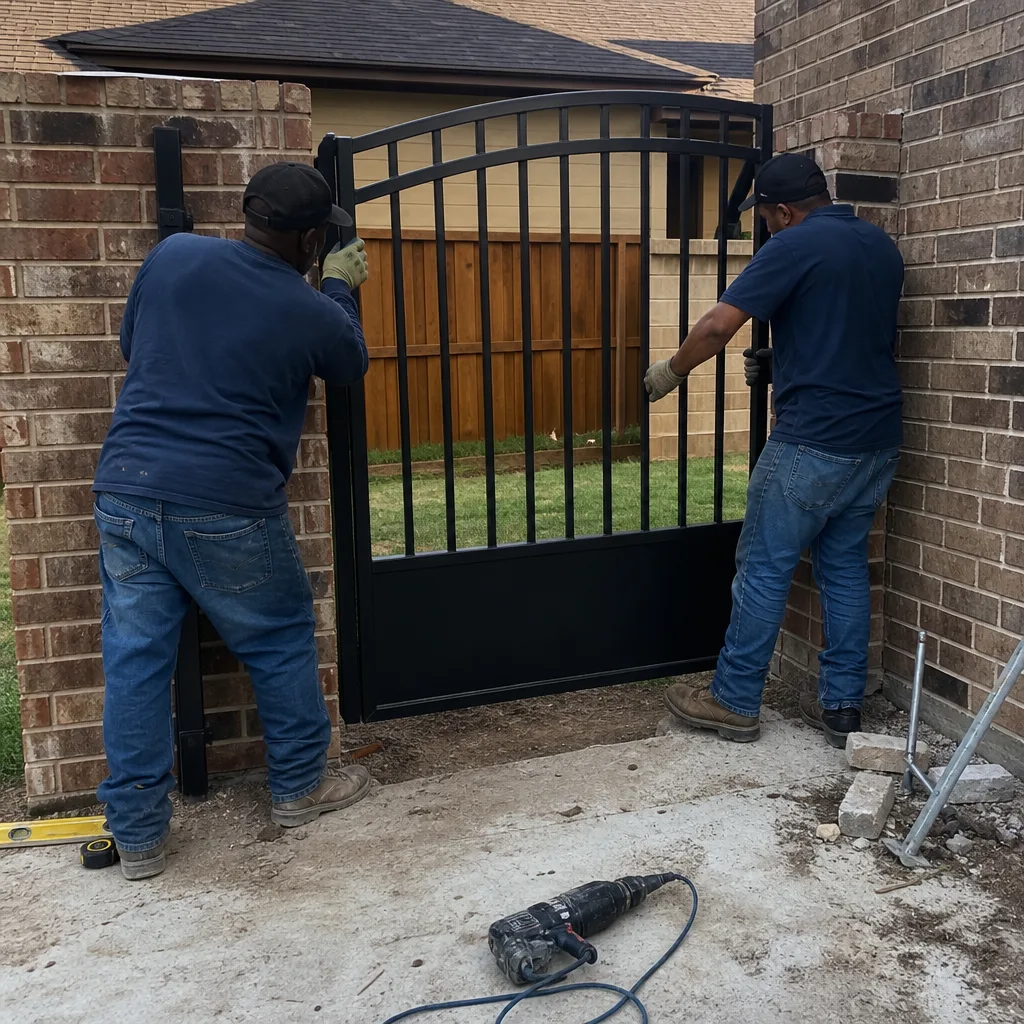
The fastest diagnostic calls start with a homeowner who knows how to send useful information. A ten-second phone video is worth more than a paragraph of description. But the video needs to show the right things. Here is the method we give our Bedford customers before they call, and it works for any gate brand.
What to capture:
- Stand back far enough to see the entire gate in frame. We need to see the full travel arc, not a close-up of a hinge. Include the ground clearance at the lowest point.
- Film one complete cycle from closed to open to closed. If the gate fails mid-cycle, keep filming. Do not stop the video when the gate stops.
- Narrate what you are feeling and hearing. Say out loud: “I pressed the remote and it took three seconds to start moving. It makes a grinding sound right at the halfway point.” Your voice on the video is more useful than a phone call description.
- Photograph the operator housing from three feet away. We need to read the brand name and any visible label. Do not open the enclosure.
- Photograph the photo-eye on both sides of the driveway. Look for anything blocking the beam path, including mulch piles, yard equipment, or a parked car’s bumper overhang.
- If rust or lean is visible, photograph it straight-on and from the side. A straight-on photo of a post lean is easy to misread; a side profile shows the true angle.
What to say when you call:
The most useful first sentence is: “My gate [specific behavior] when [specific condition], and it has been doing it for [time period].” For example: “My gate grinds on the first open of the morning and smooths out after two cycles, and it started doing it about three weeks ago.” That sentence alone narrows the diagnostic field by half. Pair it with the video, and the technician arrives with the likely part on the truck. At Vance Gate Repair, we review the video before we dispatch, and the technician arrives having already seen your exact symptom. That is the entire point of our Bedford gate service standard: the first visit is informed, not investigative.
Keypad, Remote, and Intercom Warnings: The Signals Nobody Checks
Most homeowners watch the gate itself. The access control devices are the quieter canaries. A keypad, remote, or intercom that behaves intermittently is telegraphing an electrical problem that will eventually strand someone outside the gate or lock them out entirely.
Keypad warning signs
- Cold-weather failure only: The keypad works all summer and dies when the temperature drops below 40. This is usually a failing solder joint or an aging backup capacitor inside the keypad housing. The cold contracts the joint and breaks contact.
- Specific buttons unreliable: The “9” works, the “3” does not. That is a worn key dome or a cracked membrane, not a water problem. If you have to press one number three times, the keypad is headed to full failure.
- Works after rain, not before: Humidity is bridging a marginal connection. That keypad is on borrowed time and will fail when it is most convenient for water intrusion to win.
Remote warning signs
- Distance shrinks over time: A remote that used to open from the end of the street and now needs to be within ten feet is usually a failing receiver board in the operator, not a dying remote battery. Replace the battery first; if the range does not return, the receiver or its antenna is the issue.
- Intermittent at a specific angle: RF interference from a nearby transformer, power line, or even a changed landscape feature can create a dead zone. If the remote only works when you hold it out the window at a certain angle, note the angle and tell the tech. It is diagnostic gold.
Intercom and phone-entry warning signs
- Static on the call while the gate opens: The gate motor is inducing noise into the intercom wiring, which means insulation is failing somewhere along the shared conduit.
- Calls work but the open button does not: A relay is failing inside the intercom base, or a wire has vibrated loose at the terminal block. Either way, it is a component-level repair, not a replacement of the entire intercom.
DoorKing and Elite systems are common in Bedford’s gated access points, and they each age differently; the key is catching the access device warning before it becomes a full access failure.
Motor Strain and Limit Switch Drift: The Two Most Misdiagnosed Warnings
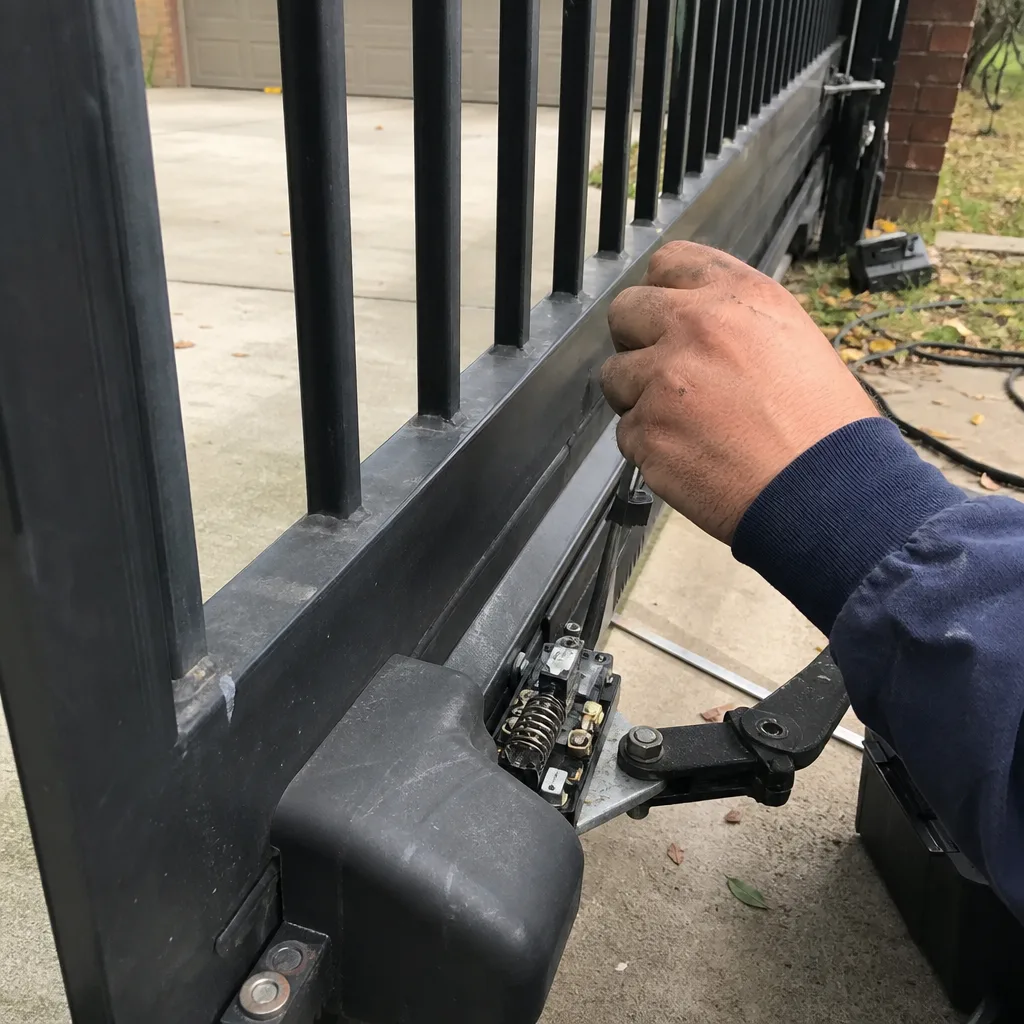
Two gate warnings walk into every Bedford service call wearing each other’s clothes: motor strain and limit switch drift. The symptoms overlap. The repairs are completely different. Misdiagnose which one you are looking at, and the repair fails within weeks.
Motor strain sounds like effort
Motor strain is the operator working harder than it should, and it shows up as a deeper hum, a hot motor housing after a cycle, or a breaker tripping repeatedly. The cause is often not the motor itself; it is the gate geometry forcing the motor to work against friction, misalignment, or added weight. A motor that runs hot on a Bedford summer afternoon is a motor being pushed past its duty cycle. The repair might be a hinge replacement, a wheel bearing, or a post reset, not a new motor. Buying a new motor and bolting it onto a gate that still fights the operator solves nothing for long.
Limit switch drift sounds like confusion
Limit switches tell the control board where the gate is in its travel. When they drift, the board gets wrong position data and responds by stopping short, overtraveling, reversing at odd points, or refusing to respond at all. The warning is behavioral, not audible. The gate acts like it has forgotten its endpoints. On LiftMaster and FAAC operators, limit drift is often a magnetic sensor that has moved a few millimeters from its set screw or a limit nut that has walked. The repair is a readjustment and re-torque, not a new motor or board. But if the drift is allowed to continue, the gate will slam into the end stop repeatedly, and that mechanical hammering will eventually damage the gearbox and the post mount, turning a $150 adjustment into a $1,000 mechanical repair.
The practical rule: if the warning is a sound, look at the mechanical load first. If the warning is a behavior, look at the limit and positioning system first. Get that order right and the repair sticks. New Bedford gate installations include a positioning calibration that sets both the mechanical travel and the limit logic to match the actual gate weight and arc, so the two do not fight each other from day one.
Common Mistakes to Avoid
- Lubricating a failed bearing. Grease will quiet a dying bearing for a few cycles and then the bearing will seize completely. The warning was not “it needs lubrication”; the warning was “it is failing.” Bedford homeowners sometimes trade a $40 bearing for a $400 carrier replacement this way.
- Ignoring the hesitation because “it still works.” The hesitation is the cheapest repair window. Waiting until the gate stops means the repair is no longer the component; it is the component and the collateral damage it caused.
- Pushing the gate manually after a power cut without disengaging the operator. Forcing a motorized gate against its gearbox can strip gears and snap the operator arm. Every operator has a manual release; use it, or do not touch the gate.
- Replacing the remote battery repeatedly while the receiver fails. If you have changed the battery twice and the range still shrinks, the problem is not the remote. Continuing to swap batteries is procrastination wearing a tool belt.
- Calling for a replacement before anyone has diagnosed the failure. A grinding gate is not automatically a new operator. We have repaired Bedford gates that other companies quoted for full replacement; the actual fix was one wheel carriage and a new seal.
- Waiting through the next rain to see if a water-related warning clears up. Water in a control board does not dry out and heal. It corrodes. The longer it sits, the more traces it eats.
When to Call a Professional
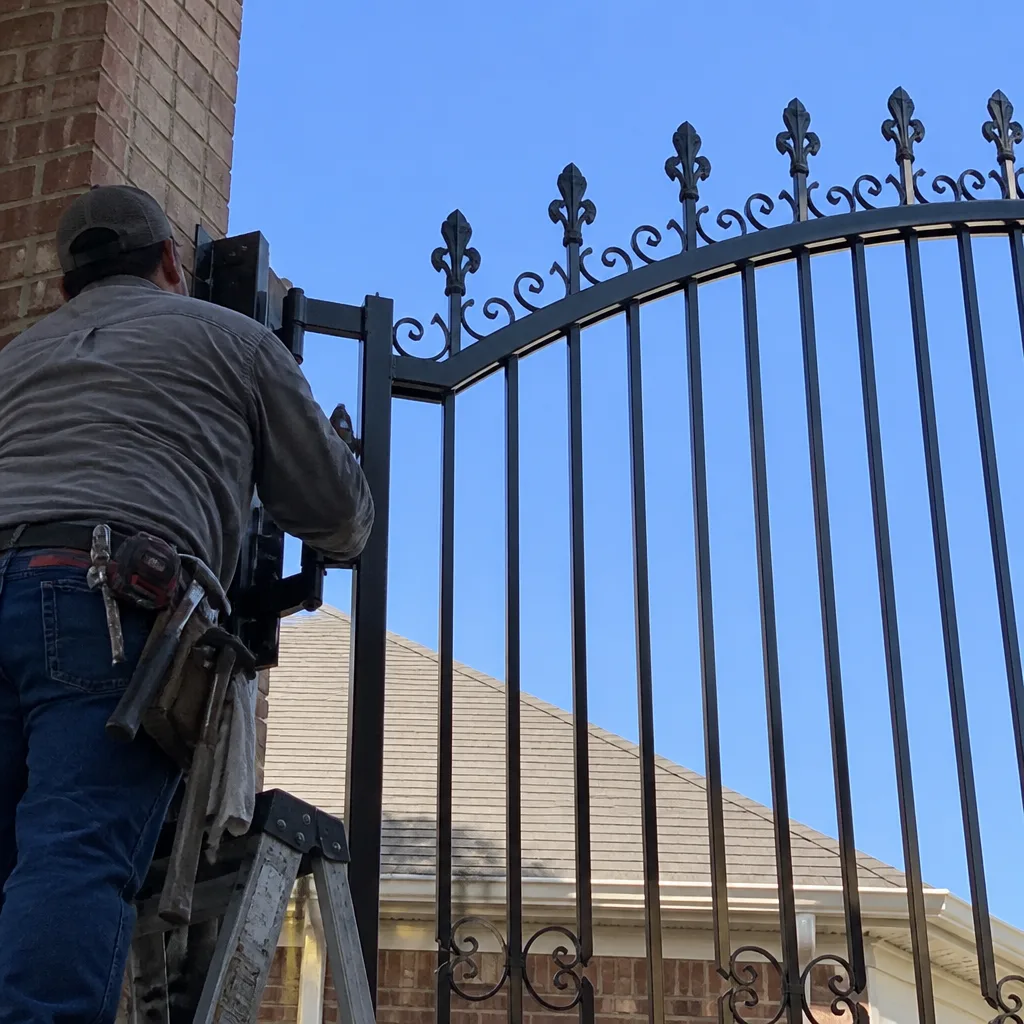
Call a gate professional the day you notice any of these: the gate reverses onto a vehicle or a person without visible cause, the motor hums without moving, the gate has dropped and drags on the concrete, the post is visibly leaning, the control box shows any sign of water inside, or the gate has failed in the locked position and you have no other vehicle exit. These are not “keep an eye on it” warnings. They are “the failure has started” warnings. A hesitation, a short-range remote, or a cracked gasket can usually wait a day or two for a scheduled visit, but photograph the symptom now, because the gate will not necessarily repeat it on demand. For help choosing the right professional, read How to Hire a Gate Repair Contractor in Bedford: A Step-by-Step Guide. Vance Gate Repair Bedford offers free estimates in Bedford - call (817) 572-8590. A live person answers the phone 24/7, and the technician who arrives has already seen your video and is carrying the likely repair parts.
Frequently Asked Questions
Most Bedford gate repairs run between $180 and $650, with hinge and wheel carriage replacements on the lower end, control board or gearbox replacements on the higher end, and full operator replacements higher still. The written price is handed to you before work begins, so there is no surprise when the job is done. Call (817) 572-8590 for a free estimate on your specific gate.
Yes. For urgent repairs, including a gate that will not close, a gate that reverses unsafely, or a gate that has trapped a vehicle, we dispatch same-day in Bedford. A live person answers 24/7, so you are never sent to voicemail when the gate is stuck open at 9 p.m.
That specific pattern points to stiff grease and a compressed bearing on a cold joint, not a failing motor. The first open pushes through the resistance and warms the bearing, and the rest of the day is quiet. The fix is a new bearing or hinge service, and it is best done before the grinding becomes constant.
An open-gate refusal to close is almost always a photo-eye misalignment, a failed close limit switch, or a stuck loop detector. Each is a separate repair, and the diagnostic tells you which one. Call (817) 572-8590 and describe the symptom; one of our Bedford techs can usually identify the likely cause over the phone before you have finished describing it.
Yes. We service nine gate-automation brands, including Ghost Controls, DoorKing, Elite, and Mighty Mule. Whatever motor is already on your Bedford property, we repair it rather than steering you toward a replacement you may not need.
Check three things: whether the gate pushes freely by hand after disengaging the operator, whether anything is visibly blocking the photo-eye path, and whether the symptom is constant or follows a pattern. Then call (817) 572-8590 and describe the pattern in one sentence. The more specific the sentence, the faster the diagnostic.
The Bottom Line
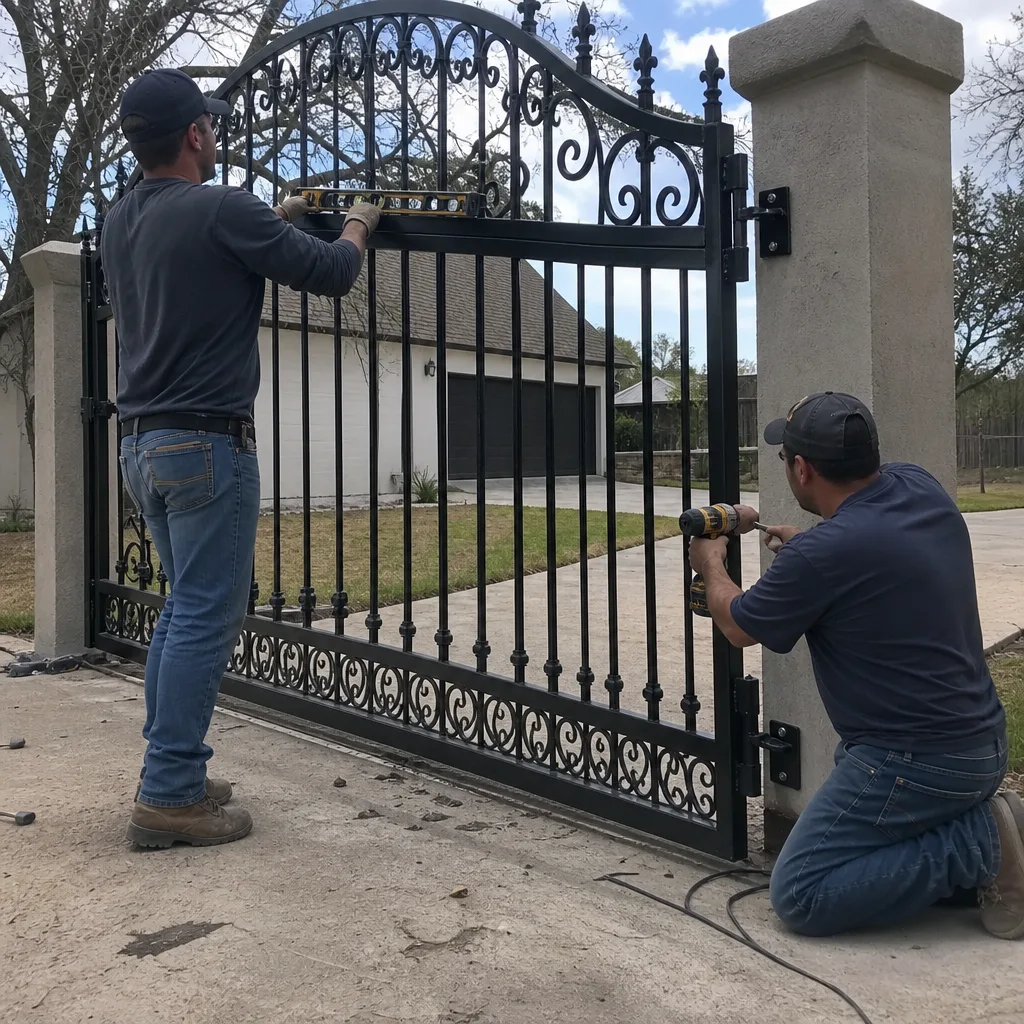
Gate warning signs are not vague omens. They are specific, repeatable behaviors tied to specific failing components, and the homeowner who learns to read them saves money, time, and the aggravation of a gate that fails at midnight or during a rainstorm. In Bedford, the soil, the sun, and the occasional hard freeze accelerate every common wear pattern, so the warnings show up sooner and progress faster. Watch for the hesitation, the first-cycle grind, the unexplained reversal, and the silent signals from keypads and remotes. For additional maintenance tips, see our guide on Seasonal Gate Repair Care for Bedford: Year-Round Homeowner’s Guide. Photograph what you see, document what you hear, and call a technician who will give you a written price before the first tool comes off the truck. That approach keeps a two-second hesitation from becoming a four-figure repair.
Written by Adrian Vance, Owner at Vance Gate Repair Bedford, serving Bedford since 2014. Explore more guides & resources on gate maintenance and repair.