
Last updated September 20, 2026
Free on-site gate assessment - hinges, posts, and your LiftMaster or Nice gate operator checked before anything is quoted
The assessment is free and the quote is the invoice.

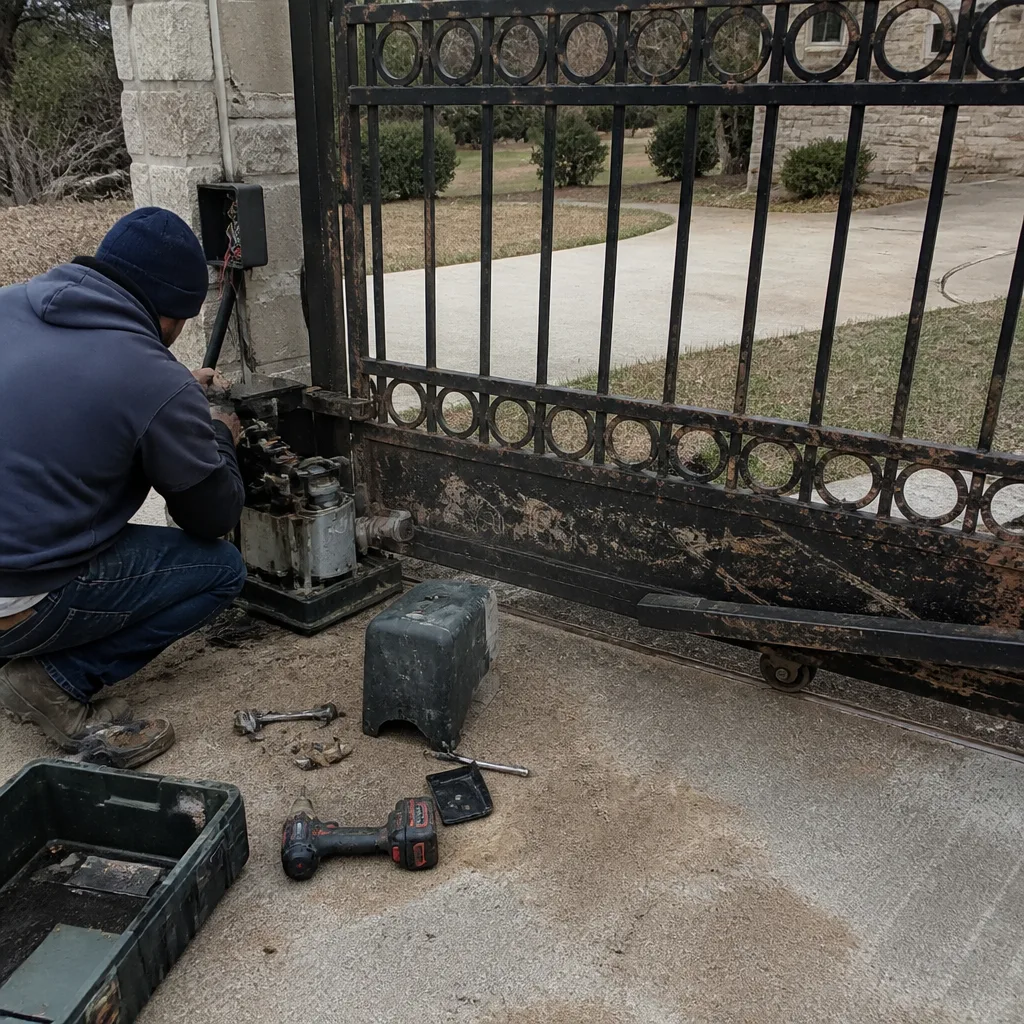 Before
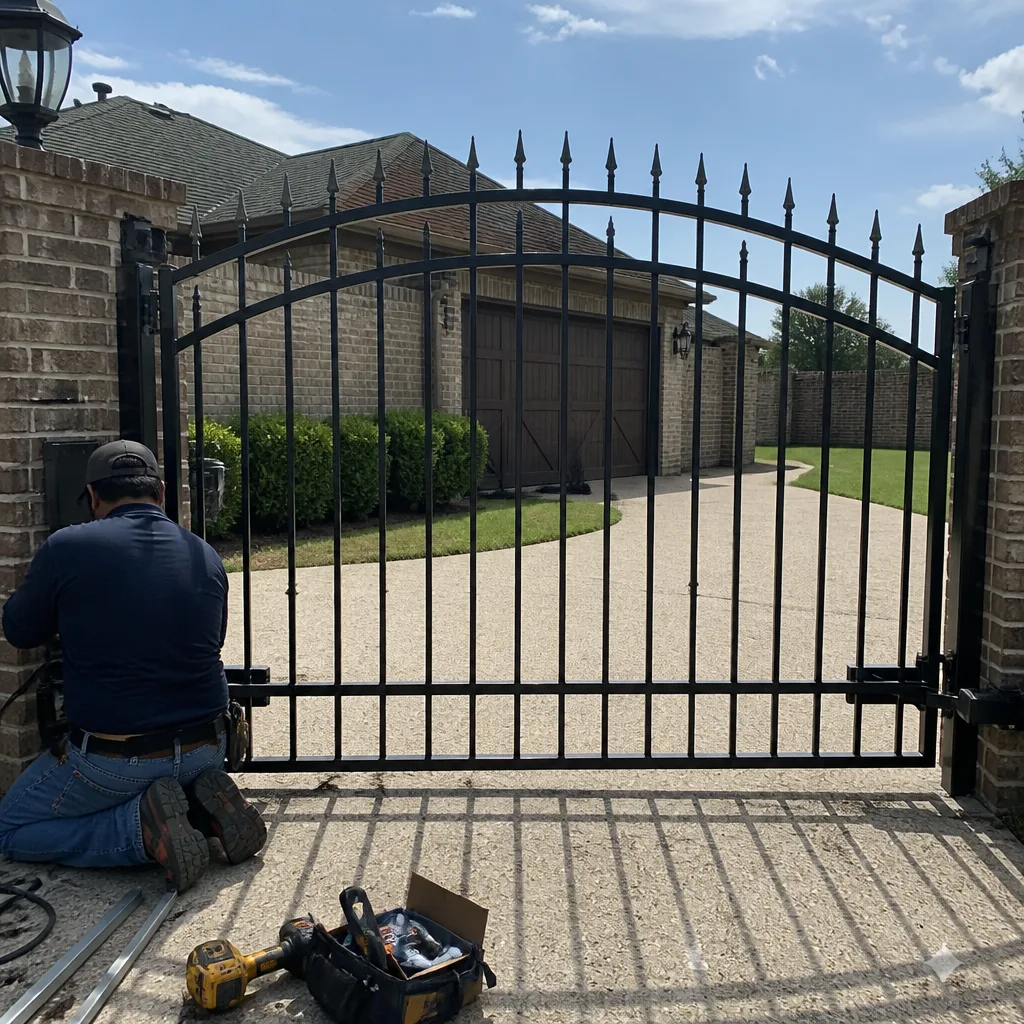 After
After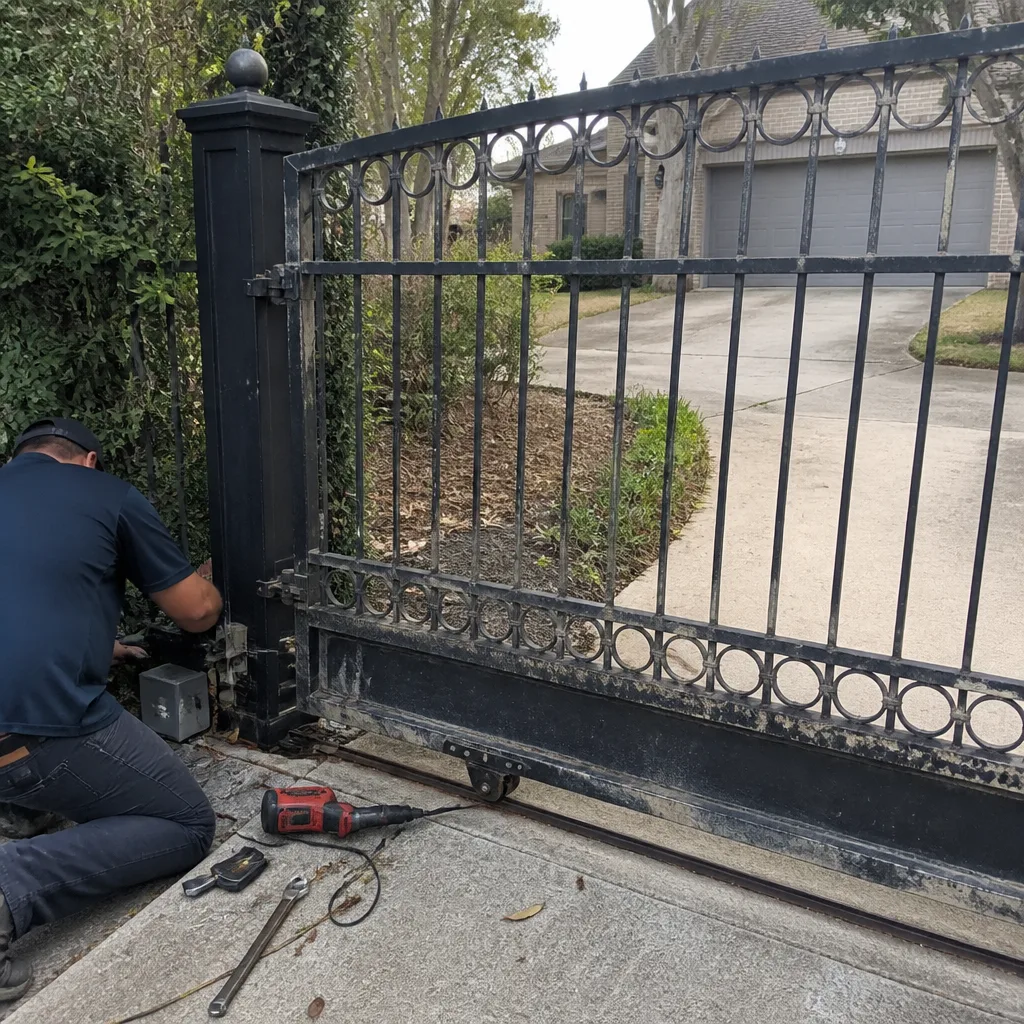 Before
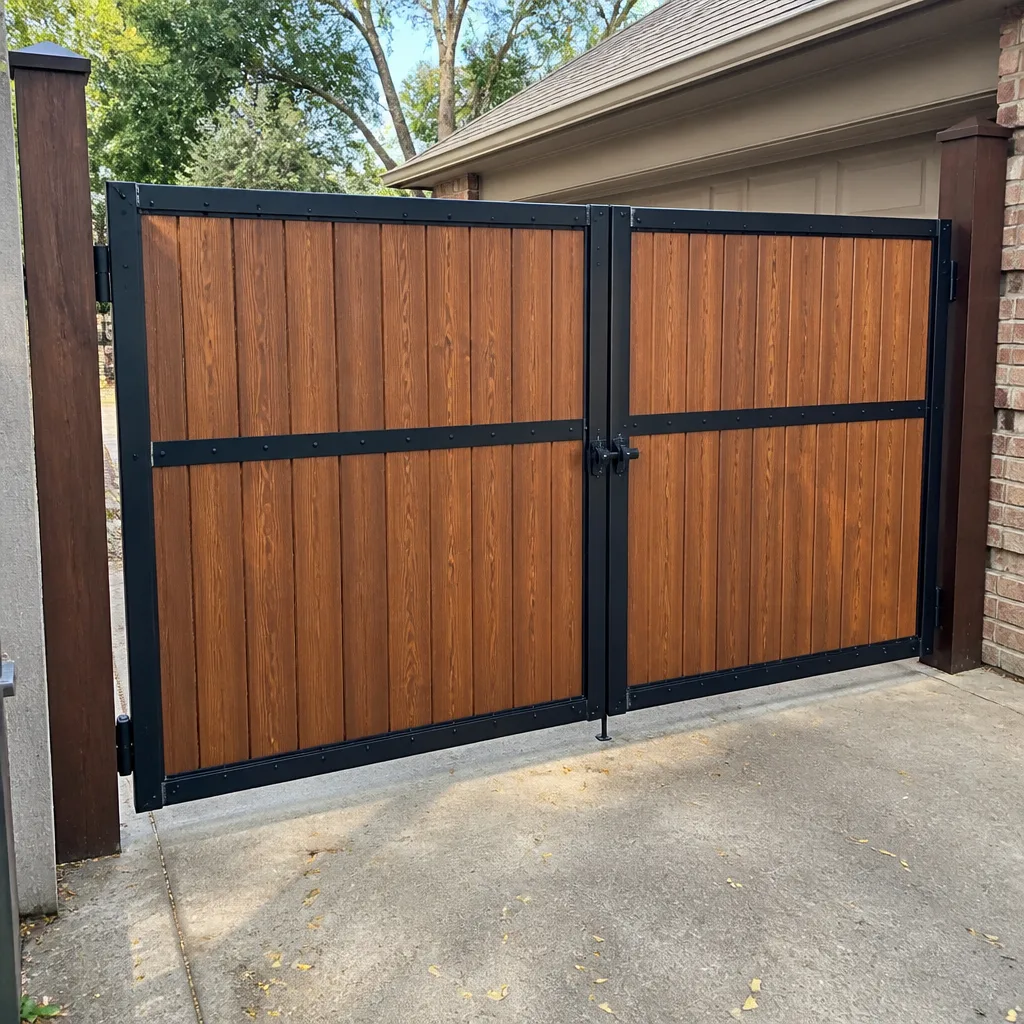 After
After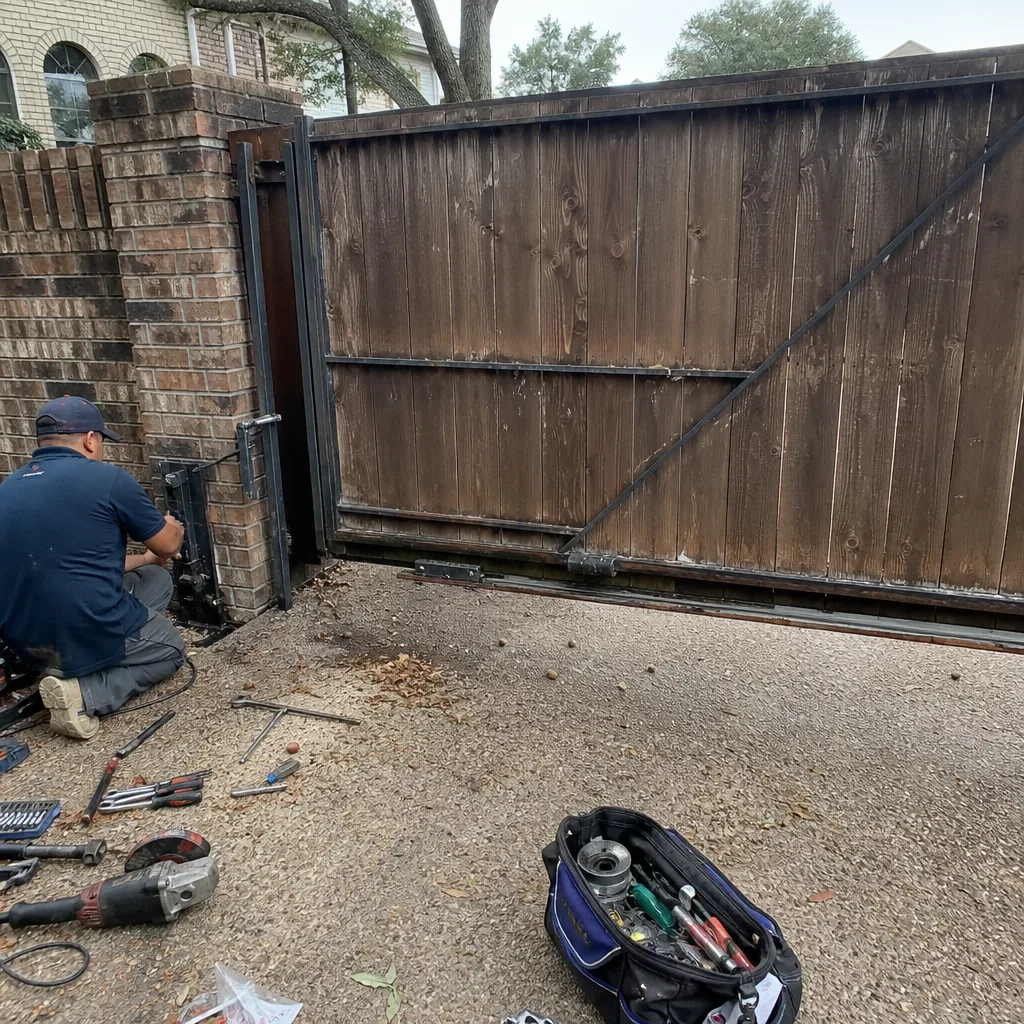 Before
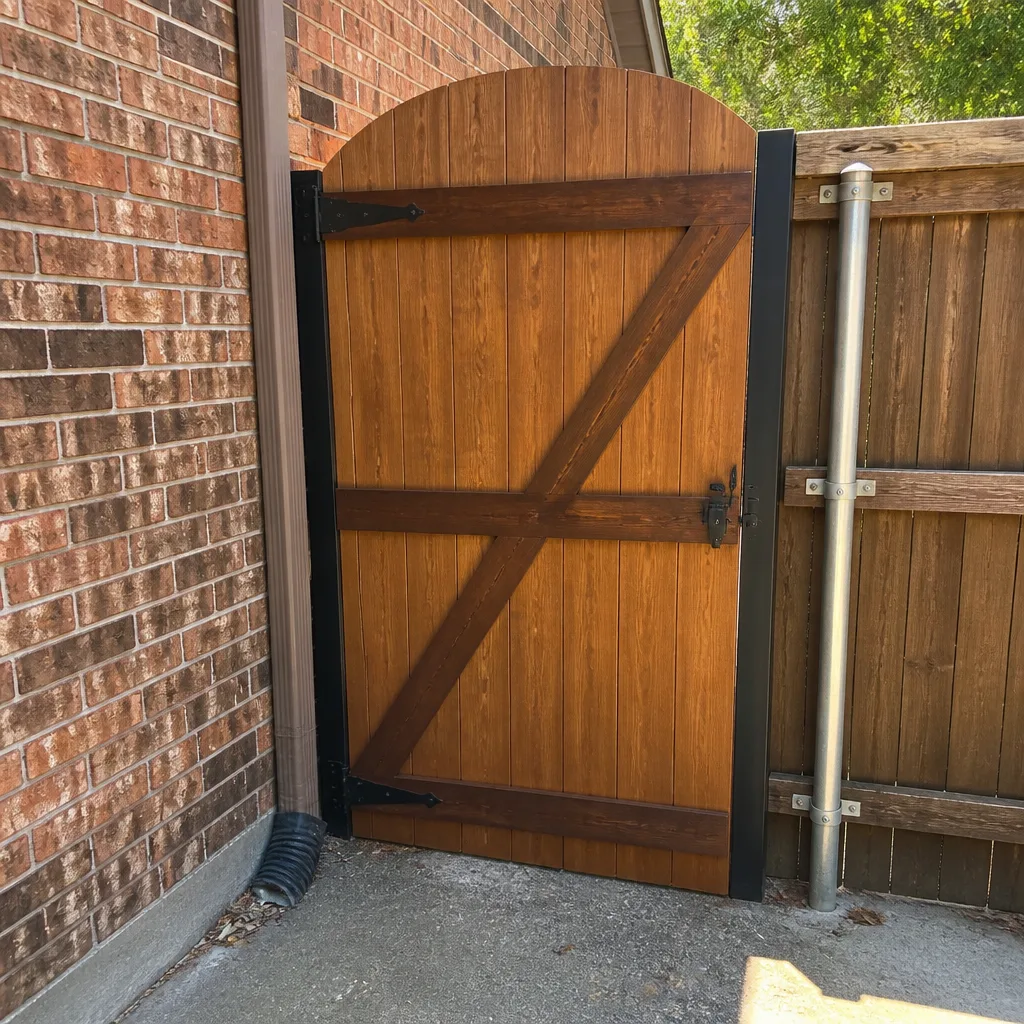 After
AfterDIY vs Professional Gate Repair: The Bedford Homeowner’s Decision Guide
A gate operator stores enough energy in its battery backup to move a 400-pound gate after the power is off. That’s the fact most DIY gate guides skip before telling you to check the terminals. This guide gives Bedford homeowners a clear framework for deciding which gate repairs are safe to attempt and which ones carry risk that no amount of YouTube confidence offsets. We’ll walk through the three criteria that actually matter, the repairs a careful homeowner can handle, what to document before you touch anything, and the Texas liability exposure most neighborhood handymen never mention.
Quick Answer
The DIY decision for gate repair isn’t about skill level. It’s about whether the repair involves stored energy, live low-voltage wiring, or a component whose failure mode is the gate striking a person or vehicle. If your repair touches any one of those three, hire a pro. If it’s cleaning, lubrication, or minor sensor alignment, a careful Bedford homeowner can usually handle it with basic tools and a phone camera for documentation.
Table of Contents
- The Three Criteria: Stored Energy, Live Wiring, and Entrapment Zones
- What’s Actually Safe to DIY on a Bedford Gate
- Document First: The Baseline Every DIY Repair Needs
- Texas Liability: What Happens When a DIY-Repaired Gate Injures Someone
- Using a Professional’s Findings as Your Gate System Roadmap
- Bedford Gate Brand Reality Check: Linear, Viking, Ghost Controls, DoorKing
- Real Cost Comparison: DIY Savings vs. Professional Repair in Bedford
- Common Mistakes to Avoid
BeforeAfterThe Three Criteria: Stored Energy, Live Wiring, and Entrapment Zones
Every gate repair question in Bedford reduces to three tests. Run your problem through them and the answer gets simple.
Criterion 1: Stored energy. A gate operator contains capacitors that hold charge even after you unplug it. The battery backup on a modern swing-gate operator can move a 400-pound gate leaf through its full arc with zero utility power. That’s by design, and it’s also why “just unplug it” is incomplete safety advice. Tensioned springs on cantilever and slide gates hold thousands of pounds of force. If your repair requires releasing, adjusting, or working near any of these, it’s a professional job.
Criterion 2: Live low-voltage wiring. Gate systems run on 12V or 24V DC, not the 120V that scares people away from outlet work. That lower voltage is exactly what makes homeowners too comfortable. Low voltage doesn’t mean no consequence. A shorted wire on a Viking or Linear control board burns a $400 circuit in under a second. A miswired photo-eye bypass creates an entrapment condition that may not reveal itself for months. The work feels approachable because the wires are thin and the connectors are plastic, but the failure cost is real money and real safety exposure.
Criterion 3: UL 325 entrapment-zone components. UL 325 is the federal safety standard governing automatic gate operators. It mandates specific protections: photo-eyes, contact edges, force settings, and alarm functions. Any component in the entrapment protection system means if it fails, the gate can strike a person or vehicle. You don’t want to be the person who adjusted the force limiter at 9 p.m. on a Saturday and then found out at 3 p.m. Sunday that it no longer reverses on contact.
In our experience serving Bedford gates since 2014, most homeowner calls fall into two buckets: the easy call where the criteria clearly say “safe” or “not safe,” and the murky middle where someone already made an adjustment and now wants us to undo it. The murky middle is the most expensive place to be.
What’s Actually Safe to DIY on a Bedford Gate
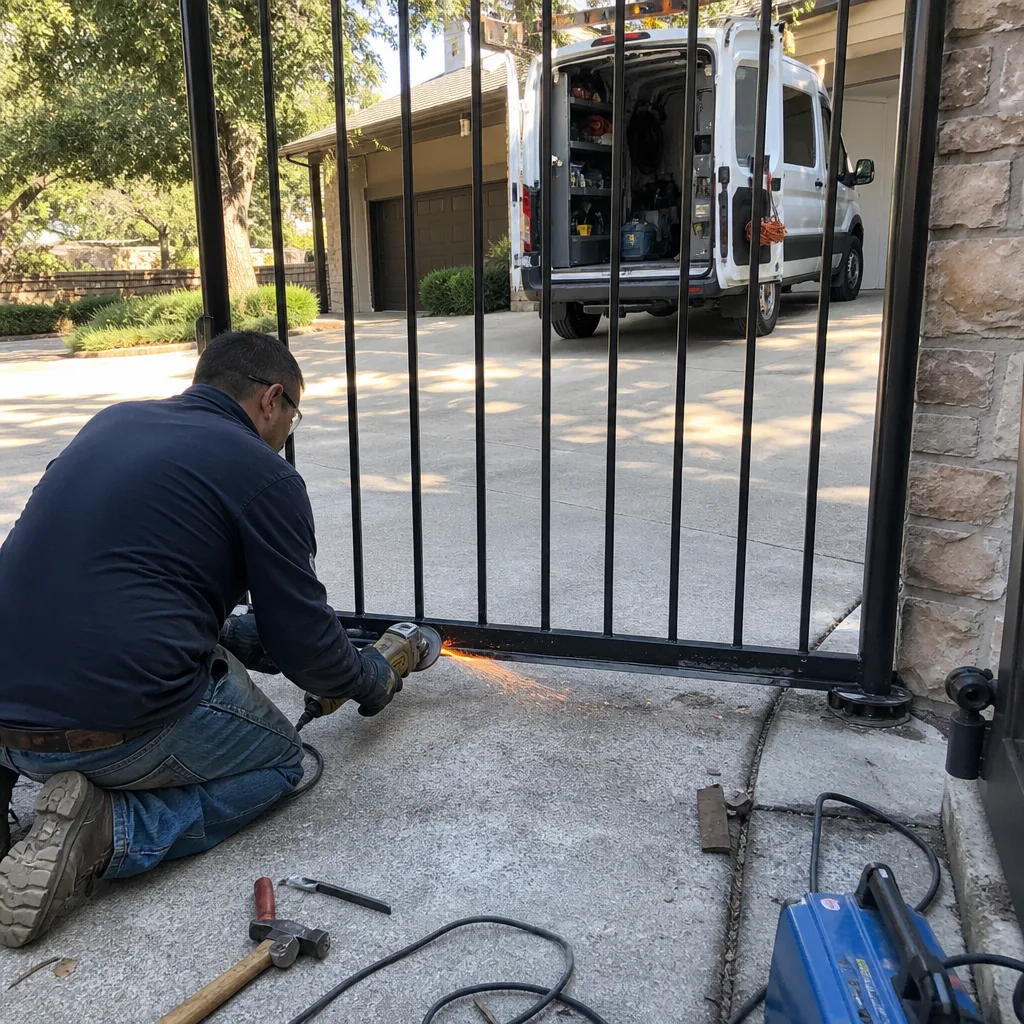
Some gate maintenance doesn’t just tolerate a careful homeowner. It’s better done by one, because you’re on-site more often than any technician will ever be. Here’s the short list of genuinely safe DIY work.
- Lubrication. Hinges, rollers, and chain drives need lubrication every 3 to 6 months in the Bedford climate, where summer heat accelerates grease breakdown and winter temperature swings make moving parts bind. Use a silicone-based lubricant, not WD-40, which displaces moisture but leaves behind almost no long-term film.
- Photo-eye cleaning. Dust, spider webs, and grass clippings collect on the lenses. A soft cloth and glass cleaner handles it. The photo-eye is an infrared beam that stops the gate if something crosses the path. A dirty lens can cause false stops or, depending on the model, a bypass signal that disables the safety function until the control board resets.
- Sensor alignment. After cleaning, check that the photo-eye transmitter and receiver face each other. Most units have an LED that turns solid when aligned. A small bracket bend can restore alignment, but do it with minimal force and photograph the position first.
- Track and rail clearing. Slide gates in Bedford collect gravel, leaves, and clay-heavy soil, especially after spring storms. Clearing the track by hand and tightening any obviously loose bolts that don’t involve the motor assembly is straightforward.
- Remote battery replacement. If your clicker works only from ten feet away, replace the battery before assuming there’s a receiver problem. This fixes more “broken” gates than any other single action.
Notice what’s missing from this list: limit switch adjustments on a motor, force setting changes, any spring tension work, any control board wiring. The line isn’t set by tool availability. It’s set by what happens if you get it wrong.
Document First: The Baseline Every DIY Repair Needs
Before you loosen a single bolt, photograph everything. The most expensive DIY gate repairs we’ve seen in Bedford weren’t caused by making a mistake. They were caused by making a mistake and then not knowing where you started from, which turns a $150 fix into a $600 diagnostic session.
Here’s the documentation sequence we use on every professional job, adapted for a homeowner working in their own driveway:
- Photograph the control board from three angles. Capture wire positions, DIP switch settings, and any LED indicators that are lit. Label the photos in your phone immediately, because three months later you won’t remember which angle showed what.
- Photograph the gate in its full open and full closed positions. Stand in the same spot for both shots. This gives you a reference for where the travel limits sit.
- Write down the brand and model number of the operator, the photo-eyes, and any accessories. The model plate is usually on the side or back of the operator housing.
- Video a full open-close cycle with sound. Audio captures hesitation, grinding, and other mechanical complaints you’ll want to compare against later.
- Note any limits, force dials, or trim pots and their current settings. A photo of the dial positions is enough. Don’t turn them.
That’s a fifteen-minute exercise. If the repair makes the condition worse, you now have a documented baseline that lets any technician, including the team at Gate Repair in Bedford, restore your gate to its previous state without guesswork. This is the same documentation habit Adrian Vance developed on commercial access-control sites starting in 2014, and it’s the single most useful thing a homeowner can borrow from the trade.
Texas Liability: What Happens When a DIY-Repaired Gate Injures Someone
Bedford homeowners don’t usually ask their insurance agent about gate liability before opening the operator housing. They should.
Under Texas premises liability law, a property owner has a duty to maintain the property in a reasonably safe condition for invitees and, in some circumstances, for trespassers. An automatic gate is a known hazard. The UL 325 standard exists because gates have killed people, and entrapment-protection components carry legal significance precisely because a court or insurance adjuster will examine whether they were properly maintained.
If a gate you repaired injures someone, and the injury involves a component in the entrapment-protection system, the question isn’t whether you meant well. The question is whether you had the expertise to touch that component at all. A photo-eye you realigned by eye, a force setting you turned up because the gate was binding, a contact edge you disconnected because it kept false-tripping: each one can be presented as evidence of negligence, not just error.
Your homeowner’s insurance may cover the claim, but only to a point. If the adjuster determines the gate was modified outside manufacturer specifications, you could face a coverage dispute. That’s a bad place to discover the difference between “I followed a forum post” and “a qualified technician set the force limiter with a torque meter.”
We’re not saying this to scare Bedford homeowners away from basic maintenance. We’re naming the line. The entrapment-protection system exists because the failure mode is a person, not a broken part. Everything upstream of that system is mechanical or electrical. Everything inside it is safety-critical. The legal system already knows the difference. So should you.
Using a Professional’s Findings as Your Gate System Roadmap
You can hire out every gate repair for the rest of your ownership and still become the most informed owner on your block. The trick is asking for documentation. Not a receipt. A record.
When a reputable gate company finishes a repair in Bedford, they should be able to tell you what they found, what they changed, and what they set. That’s the entire point of our Haven Standard, which requires a written price before work starts and a photographed record when the technician leaves. Under Clause 4 (Evidence on every job), every visit includes a documented photo record at no additional charge.
Here’s what to ask for and why it matters:
- Wire-by-wire photo documentation of the control board. If a wire pulls loose next year, you start from a photograph instead of a wiring diagram you don’t have.
- Limit-switch readings. If a technician tells you the limit switch was set 12 degrees past travel and they reset it, that number is your baseline. You’ll know if it drifts again.
- Force-setting values. On operators with digital force readouts, the specific number matters. If the gate starts binding and the current spikes, you can see it in the data before you feel it in the gate.
- Part numbers installed. When a technician replaces a capacitor, a limit switch, or a battery, the part number goes on the invoice. That’s your single source of truth for future maintenance.
A homeowner who collects these records over five years has a service history more complete than most commercial properties maintain. That record is leverage when selling the house, clarity when something breaks, and the best insurance against paying twice to rediscover the same problem. The professional’s findings are a roadmap you keep even if you never do another repair yourself.
Bedford Gate Brand Reality Check: Linear, Viking, Ghost Controls, DoorKing
One of the quiet frustrations of Bedford gate ownership is discovering that your gate company only works on one brand, usually the one they sell. Gates don’t work that way. By the time a Bedford house is ten years old, the original operator may have been replaced once, the photo-eyes updated, and the remote receiver swapped for something the previous owner found on sale.
Here’s what we actually see on Bedford driveways:
- Linear is the workhorse of Texas residential slide gates. The control boards are repairable, the parts are broadly available, and many Linear operators from the late 2000s are still running well with basic maintenance. Common Bedford failure mode: capacitor degradation after years of summer heat.
- Viking operators appear more often on heavier custom gates and light commercial properties. They’re robust but less tolerant of voltage instability, which matters in older Bedford neighborhoods with aging transformers.
- Ghost Controls is the DIY-adjacent brand we see frequently on newer installations. The engineering is accessible, which means more homeowners attempt their own repairs. Some succeed. Many don’t, usually because the force setting wasn’t recalibrated after a hinge replacement.
- DoorKing is the oldest name on this list and still common on Bedford properties with long driveways and heavier gates. DoorKing parts are easy to source, but the company’s wiring conventions differ enough from other brands that a technician who learned on one system can misdiagnose the other.
Our shop services all of these plus five more automation brands. The reason we name them isn’t to flex. It’s to make a point about the repair-versus-replace question. A company that only carries one brand has a business incentive to declare your existing operator dead, because their profit lives in the new installation. A company that works across brands can tell you honestly whether that Viking board is repairable or actually past economical life. For a deeper look at operator service, see Gate Motor & Opener in Bedford.
Real Cost Comparison: DIY Savings vs. Professional Repair in Bedford
The cost question is usually the first one asked and the least important one answered. For a detailed look, see our Gate Repair Cost Breakdown: The Bedford Homeowner’s Reference for 2026. Here’s the real Bedford math.
| Repair | DIY Cost Range | Professional Cost Range | What You’re Actually Buying |
|---|---|---|---|
| Photo-eye cleaning and alignment | $0-$15 (cleaner, cloth) | $85-$150 service call | Time saved, no real risk either way |
| Remote battery replacement | $5-$12 | $65-$110 | Convenience; DIY is the right call |
| Limit switch adjustment | $0 (if you already own tools) | $120-$200 | Expertise and a documented setting |
| Capacitor replacement | $40-$90 in parts | $180-$300 | Safety: capacitor discharge is not optional |
| Control board diagnosis and repair | $100-$400 in parts, typically with no diagnosis framework | $300-$700 depending on the board and brand | A correct answer instead of a parts guess |
| Force setting recalibration | $0 (no special tool needed, which is the problem) | $100-$180 | UL 325 compliance and liability coverage |
The savings math changes shape when you account for the cost of a wrong guess. We’ve seen Bedford homeowners buy a $200 control board on suspicion, install it, and discover the real problem was a $25 limit switch. The professional’s diagnosis fee covers what the homeowner burned in parts, and the technician would have known within ten minutes.
The price at Vance Gate Repair Bedford is always written and handed over before anything gets touched. You know the flat cost before you commit. That’s the fulfillment of Haven Standard Clause 1 (Have it in writing), and it’s the reason we can publish honest cost ranges in the table above instead of telling you to call for a number we already know. For homeowners weighing repair against full replacement, Gate Installation in Bedford walks through that decision in detail.
Common Mistakes to Avoid
- Unplugging the operator and assuming the stored energy is gone. Capacitors hold charge after the mains are disconnected. The battery backup on many Bedford swing-gate operators runs on its own circuit. Discharging a capacitor requires a specific procedure, not just patience.
- Adjusting the force limiter to “fix” a binding gate. When a gate binds, the proper fix is finding the mechanical obstruction: a misaligned roller, a sagging hinge, a warped leaf. Turning up the force so the gate pushes through the binding trades a maintenance problem for an entrapment hazard, and UL 325 exists to prevent exactly that trade.
- Bypassing a photo-eye that keeps false-tripping. A photo-eye that triggers the gate to reverse mid-cycle is doing its job or signaling misalignment. Bypassing it electronically is the single most dangerous modification a homeowner can make, and it’s the one we see most often in Bedford.
- Replacing parts on suspicion instead of diagnosis. Control boards, capacitors, and photo-eyes are not interchangeable guesses. Bedfford homeowners who replace parts on a hunch usually accumulate a shelf of “good” parts that weren’t the problem, then pay for the diagnosis anyway.
- Using WD-40 on chains and rollers. It dissolves built-up grease and leaves a thin film that attracts dust. In Bedford’s dry seasons that dust becomes a paste. Use a proper silicone lubricant or white lithium grease.
- Not photographing the starting position. Every adjustment changes multiple variables. Without a baseline, a minor adjustment that goes wrong costs you a technician’s full diagnostic time to reconstruct what you started from. The photo costs nothing.
- Assuming your gate brand is proprietary and simple. A Linear board and a DoorKing board use different wiring conventions, different DIP switch logic, and different diagnostic LED languages. YouTube videos for one brand don’t transfer to another, and a Bedford homeowner who learns this mid-repair usually learns it the expensive way.
When to Call a Professional
Call a gate technician when the repair touches a spring, a capacitor, a control board, a force setting, or any UL 325 entrapment-protection component: photo-eyes, contact edges, reversing mechanisms, and alarm functions. Call when the gate makes a new noise, when it starts and stops unexpectedly, or when it reverses without an obstruction. Call when you’ve already adjusted something and the gate now behaves worse than before you touched it. And call if you simply don’t want the liability question hanging over your driveway. Vance Gate Repair Bedford offers free estimates in Bedford. Call (817) 572-8590 and you’ll get a written price before any work begins. For a fuller picture of our general repair work, visit the Vance Gate Repair Bedford home page.
Frequently Asked Questions
You can clean photo-eyes, lubricate hinges and rollers, clear slide-gate tracks, and replace remote batteries without professional help, as covered in our Gate Repair Maintenance Checklist for Bedford Homeowners. Anything involving the control board, limit switches, force settings, capacitors, springs, or entrapment-protection components should go to a trained technician, and Bedford’s seasonal temperature swings make mechanical adjustments on gates less forgiving than in more stable climates. Call (817) 572-8590 if your repair touches any of the safety-critical components, and you’ll get a straightforward answer before any money changes hands.
Expect $85 to $150 for a basic service call covering photo-eye alignment, lubrication, and minor adjustments. Control board diagnosis and replacement runs $300 to $700 depending on the brand. Full operator replacement starts around $800 and goes up from there based on gate weight, brand, and site conditions. Every price at Vance Gate Repair Bedford is written and handed to you before work starts, so the number you see is the number you pay. Call (817) 572-8590 for a free estimate.
Photo-eye misalignment and dirty lenses are the most common issues we see across Bedford, usually caused by wind, lawn equipment vibration, and dust accumulation. Capacitor failure on older Linear and Viking operators is a close second, accelerated by years of North Texas summer heat. Battery backup failure rounds out the top three: most Bedford homeowners don’t realize their backup battery has a service life of 3 to 5 years until the power goes out and the gate won’t move.
The stored energy in capacitors and battery backups can deliver a harmful shock even with the operator unplugged. Tensioned springs on slide and cantilever gates hold enough force to cause serious injury if released incorrectly. Entrapment-zone components, when adjusted improperly, convert the gate into a crushing hazard. Those three risks are the reason the DIY line in this guide is drawn where it is, and why any repair in those areas belongs with a professional. Call (817) 572-8590 if you’re not certain which side of the line your repair falls on.
A professional repair at Vance Gate Repair Bedford includes a written price before work starts, a documented photo record of what was found and what was changed, and a 365-Day Done Right Promise covering the completed work. Under Haven Standard Clause 4, every visit includes photographic evidence of adjustments, which means the next technician on your gate never has to guess what the last one did. Call (817) 572-8590 to schedule a repair or get a free second opinion on another company’s written estimate.
Most gate repairs in Bedford do not require a permit, including operator replacement on an existing gate. A new gate installation with new posts and footings typically does require a residential building permit, and your gate company should confirm current requirements with the city before starting. This question matters less for repair work and more for full installations, so if your repair turns into a replacement conversation, ask about permits before you sign anything.
The Bottom Line
Most gate repair questions in Bedford answer themselves once you apply the three criteria: stored energy, live wiring, and entrapment protection. If your repair doesn’t touch any of them, you can probably handle it with basic tools and a phone camera, as outlined in our more guides & resources. If it does, the money you think you’re saving is actually a down payment on a larger repair. Document everything either way. A gate with a photographic history is cheaper to maintain, easier to sell with the house, and far less likely to surprise you. When the job crosses the line, call (817) 572-8590 and get the price in writing before anyone picks up a tool.
Written by Adrian Vance, Owner at Vance Gate Repair Bedford, serving Bedford since 2014.