
Last updated September 20, 2026
Free on-site gate assessment - hinges, posts, and your LiftMaster or Nice gate operator checked before anything is quoted
The assessment is free and the quote is the invoice.

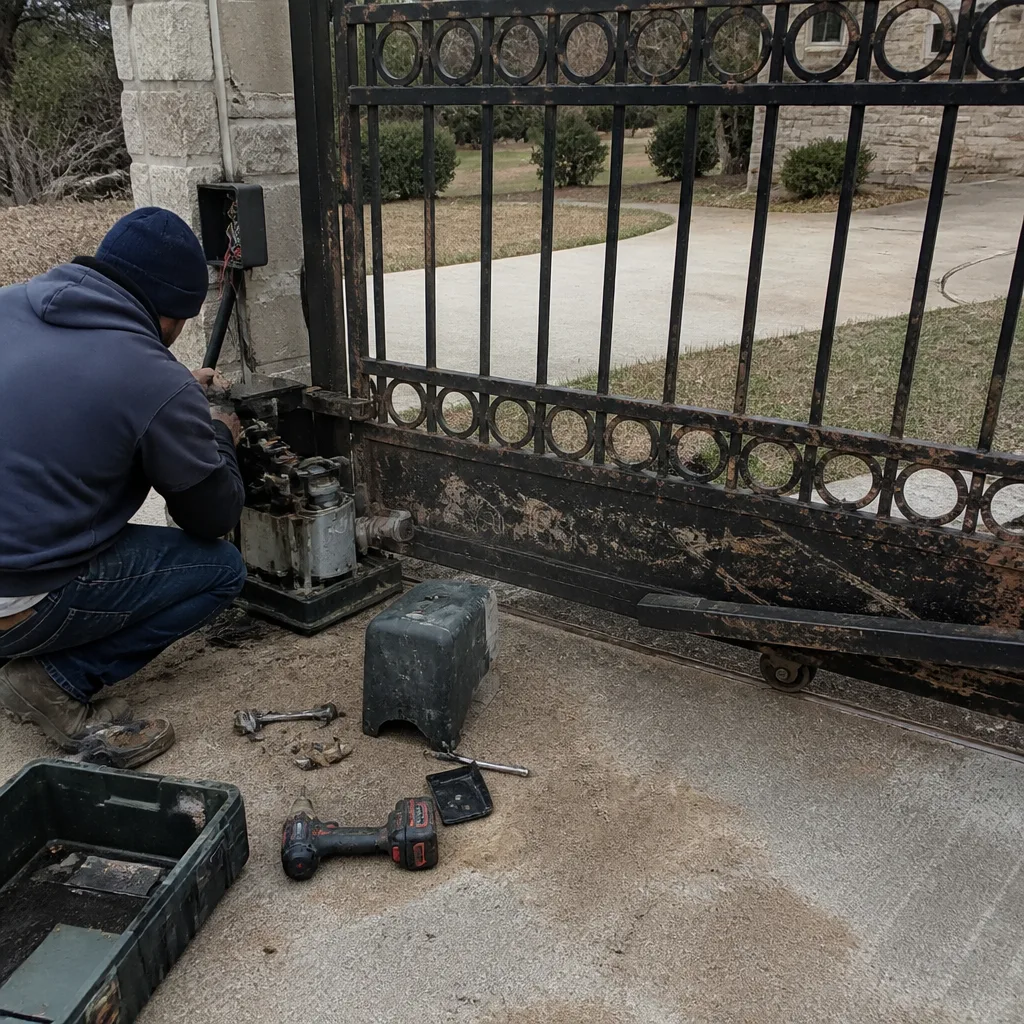 Before
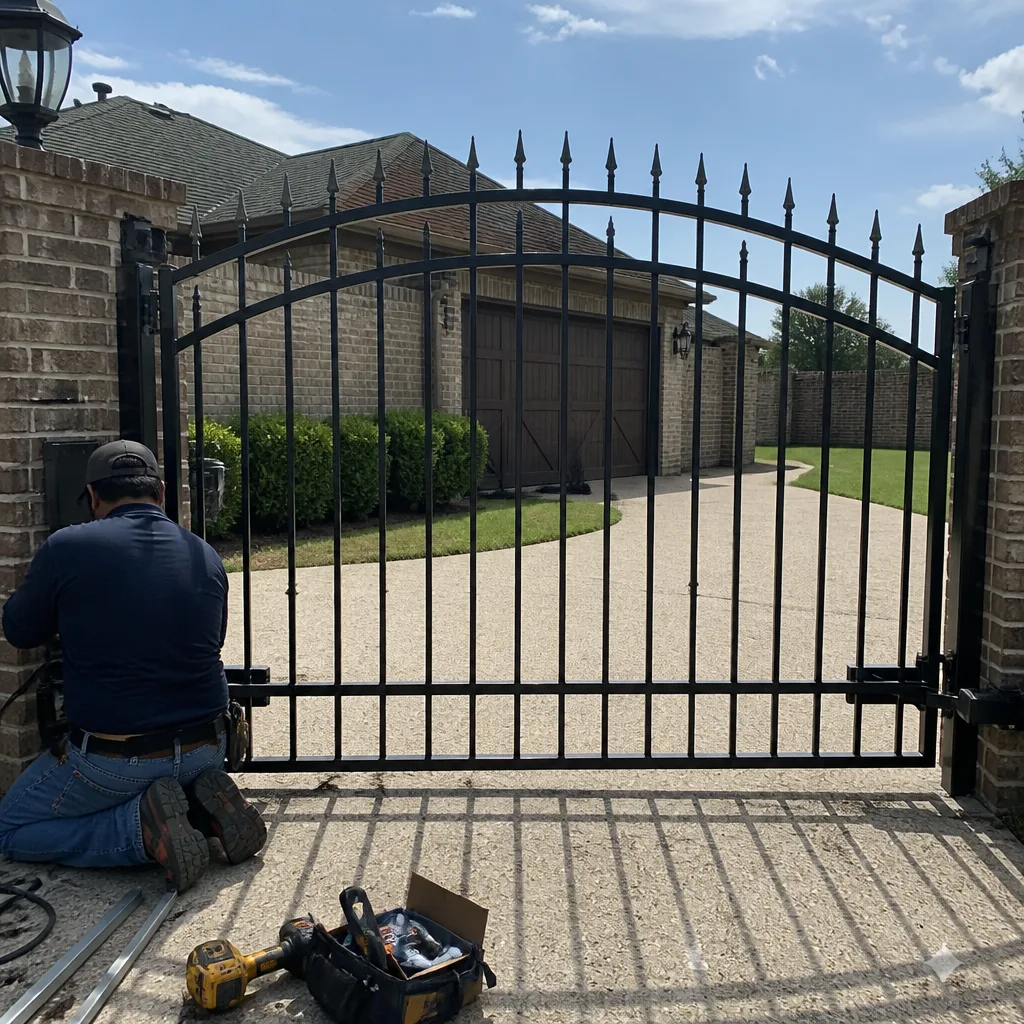 After
After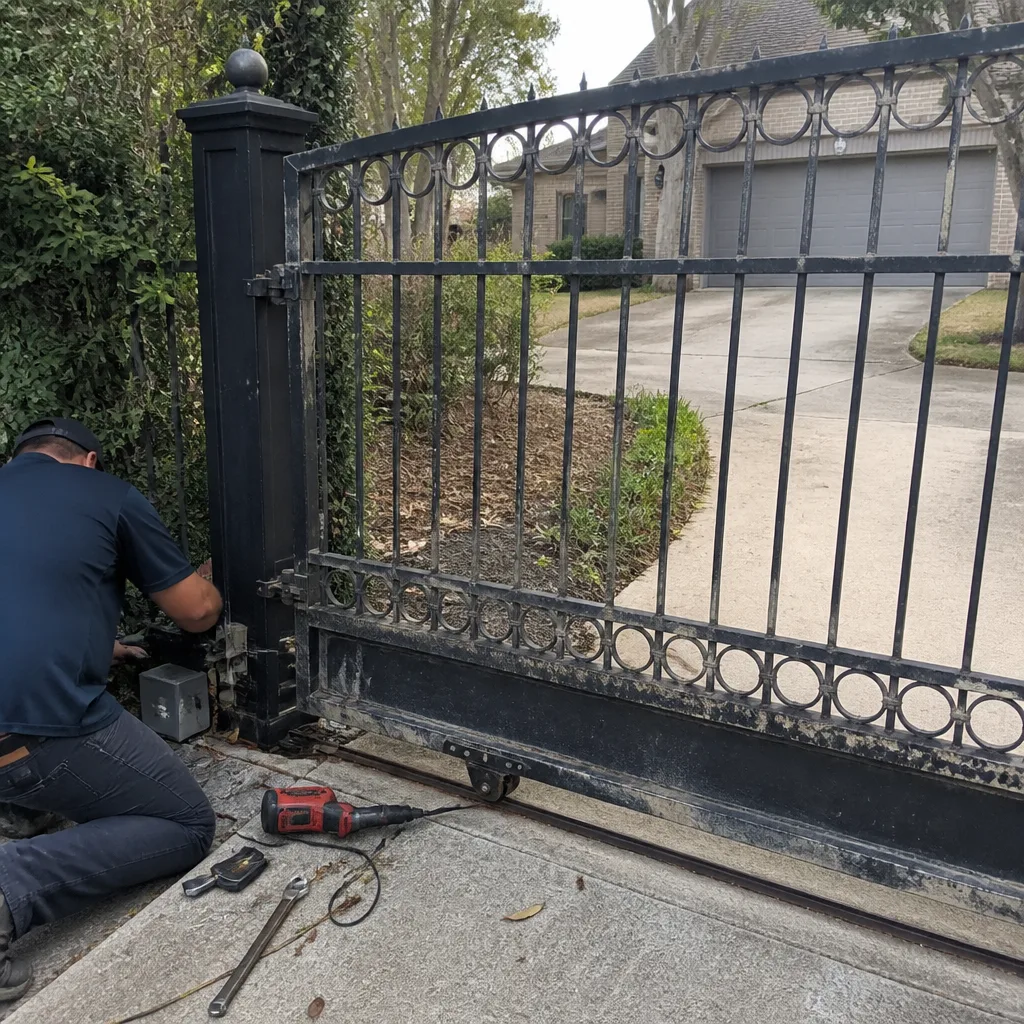 Before
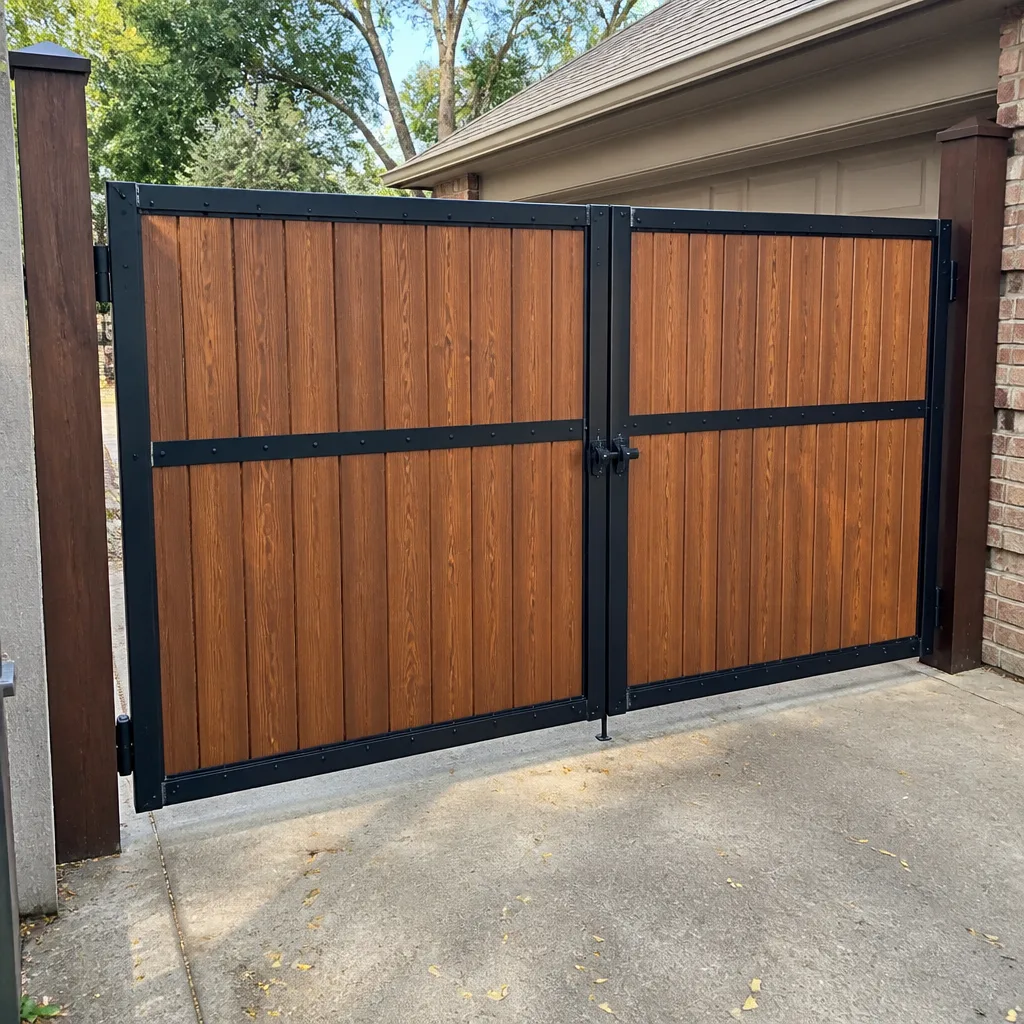 After
After Before
 After
AfterThe Complete Guide to Gate Repair in Bedford
A gate that reverses halfway open isn’t necessarily a motor problem. In Bedford, we routinely open control boxes where the limit switch has drifted two millimeters and the owner has been quoted a full operator replacement by someone who never opened the panel. Misreading the symptom is how homeowners in Bedford end up paying $2,400 for a job that needed a flathead screwdriver and ten minutes. This guide maps the most common gate failures in Bedford back to one of three root causes: alignment, power supply, and water intrusion. By the time you finish reading, you’ll be able to walk a technician through the symptom with precision, or in many cases, know exactly what to check yourself before spending a dollar.
Quick Answer
Most residential gate failures in Bedford trace back to one of three root causes: mechanical alignment drift, interrupted or degraded power supply, and water or corrosion damage to control boards and limit switches. Gate repair in Bedford typically costs between $145 and $580 for common mechanical and electrical fixes, while full operator replacements run $1,200 to $2,800 depending on brand and duty cycle. The fastest way to avoid paying for the wrong repair is to trace the exact symptom, not the part you suspect, before calling anyone.
Table of Contents
- The Three Root Causes Behind Most Bedford Gate Failures
- How to Trace a Gate Symptom Before Ordering Any Part
- Residential vs. Commercial-Grade Gate Systems: What the Difference Means in Bedford
- Why the Wiring Diagram Left at Installation Predicts Your Next Repair Bill
- Bedford-Specific Conditions: Corrosion, Caliche Soil, and Hinge Wear
- Repair or Replace? A Decision Tree for Gate Operators
- Common Mistakes to Avoid
- When to Call a Professional
- Frequently Asked Questions
BeforeAfterThe Three Root Causes Behind Most Bedford Gate Failures
Every gate problem we’ve documented in Bedford since 2014 falls into one of three categories. Not four, not twelve. Three. And once you know which category you’re in, the repair path becomes remarkably predictable. The experience of thousands of service calls in this city bears it out: alignment, power, or water. Everything else is a variation.
Root Cause 1: Alignment Drift
Gates are weighted structures swinging or sliding on hinges, rollers, and tracks. Bedford’s clay-heavy soil expands and contracts with moisture, and over two to five years, that movement shifts gate posts by fractions of an inch. A quarter-inch post shift at the hinge translates to a two-inch sag at the latch. Limit switches, the sensors that tell the operator where “open” and “closed” live, don’t fail from age. They fail because the gate’s travel path changed slowly while the switch setting stayed put. The symptom looks like a motor problem, but the root cause is mechanical drift.
Common alignment-driven failures in Bedford:
- Swing gates that reverse halfway open because the arm bracket angle changed
- Slide gates that grind or shudder because the track settled unevenly
- Gates that stop two inches short of full close or full open, tripping the safety reversal
- Latches that no longer line up with the strike plate by a visible margin
Alignment issues are typically the least expensive to fix and the most commonly misdiagnosed as operator failure.
Root Cause 2: Power Supply Degradation
Gate operators in Bedford pull power from the house panel through a dedicated circuit, or in some older installations, from a shared garage circuit that was never rated for the startup draw. What homeowners see as “the motor is weak” is often voltage drop at the board. A transformer that tests at 24V under no load may collapse to 17V when the arm engages, and the board reads that as a fault and shuts the cycle down. Battery backup units installed five or more years ago in Bedford are particularly prone to this, since summer heat shortens sealed lead-acid battery life considerably in Tarrant County.
Power-related failures show up as:
- Intermittent “no response” from remotes and keypads
- Gates that start a cycle and stop with no obstruction present
- Operators that work fine in the morning but fail in the afternoon heat
- Control boards that reboot or clear programming spontaneously
We test the power supply before touching the motor, every time. In our experience, roughly three in ten “dead operator” calls in Bedford are actually dead transformers, blown fuses, or corroded junction connections.
Root Cause 3: Water Intrusion
Bedford averages roughly 38 inches of rain per year, with concentrated spring and fall storms. Control boxes mounted at grade level, especially on older installations, take water during heavy downpours. Even sealed enclosures fail when drain holes clog with mud dauber nests or grass clippings. Once water reaches the control board, corrosion begins silently. The board may function for months, then fail suddenly when a corroded trace opens under load.
Water intrusion signs include:
- White or green corrosion visible on board terminals
- Condensation inside the control box on dry days
- Ants or other insects nesting in the enclosure (they follow moisture)
- Rust staining running down from the enclosure seams
Water damage on the board is a replace, not repair situation. But catching the intrusion early, by keeping drain holes clear and checking seals, prevents a $400 board failure with a five-minute maintenance habit.
How to Trace a Gate Symptom Before Ordering Any Part
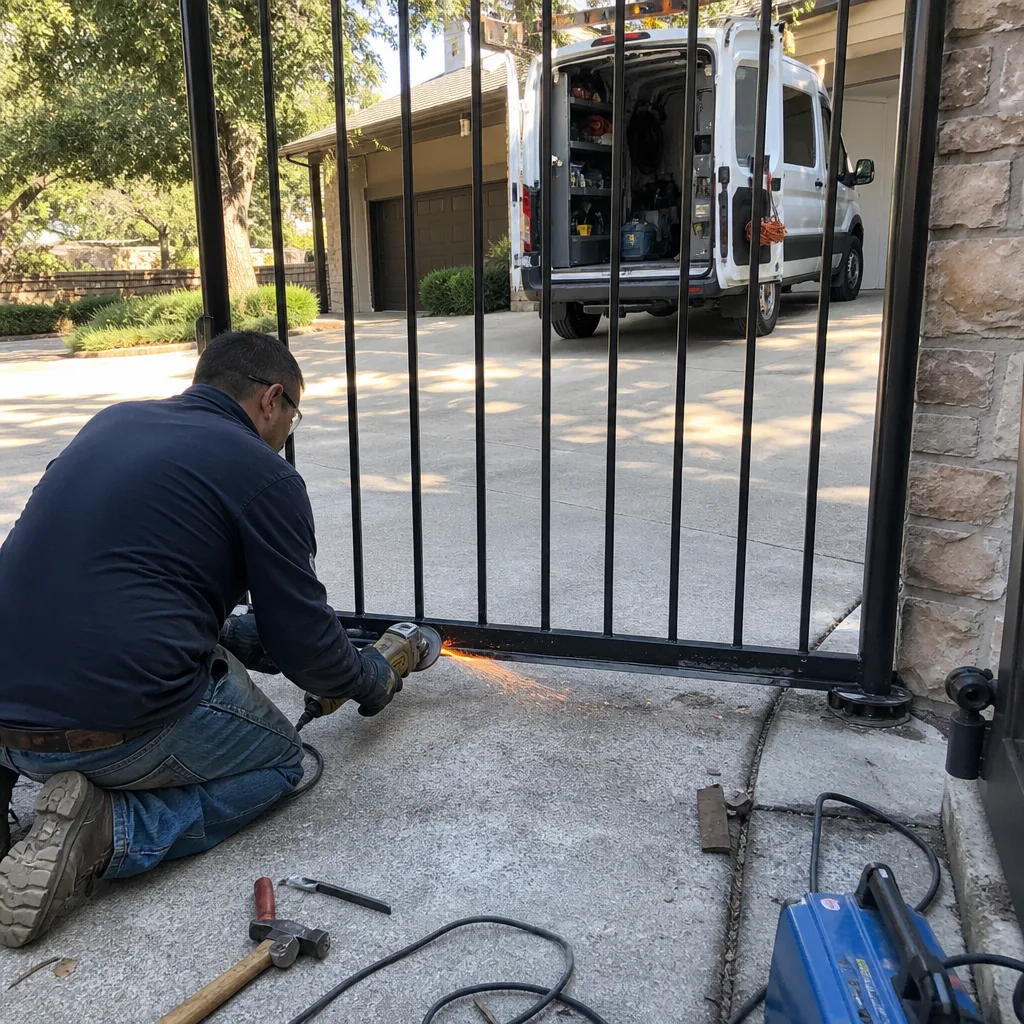
Before you call a gate company in Bedford, spend eight minutes running through this sequence. The goal is to know which root cause you’re dealing with so the technician who arrives can’t sell you a diagnosis you don’t need. Here is the exact process we use on our own service calls, in the order we use it.
- Disconnect the operator arm. If the gate can be pushed open and closed by hand without binding, the gate structure and hinges are sound, and the problem is in the operator, the power supply, or the controls. If the gate binds, drags, or catches, stop here. The issue is alignment or mechanical wear, and no motor swap will fix it.
- Check for power at the outlet the operator plugs into. Verify the outlet is live with a known-good appliance. Reset the GFCI if tripped. Many Bedford homes have the gate operator on a GFCI circuit that trips after storms.
- Watch the indicator lights on the control board. Most operators from LiftMaster, FAAC, BFT, and Mighty Mule have diagnostic LEDs that blink in specific patterns for specific faults. Photograph the pattern before calling. That photograph is the single most useful piece of information you can hand us.
- Test the photo-eye alignment. The photo-eye is the infrared beam that stops the gate if something crosses the path. If the gate reverses immediately after starting, the beam is likely misaligned or blocked by a leaf, a spider web, or a shifted post.
- Inspect the control box for moisture. Open the enclosure if dry and safe to do so. Look for condensation, corrosion, insect activity, or standing water. If you find any, the board may still function, but you’ve identified the likely future failure point, and the current symptom may be a board being asked to operate with compromised circuitry.
- Record the symptom with specificity. Not “the gate doesn’t work.” The precise sequence: “The gate opens halfway, pauses for two seconds, reverses to closed, and the remote beeps three times.” That sentence alone narrows the diagnosis to a short list of probable causes.
Six steps, eight minutes, and you know more about your gate than most homeowners in Bedford know after two service visits. That knowledge protects you from unnecessary parts and gives any technician a head start. We work from evidence, and this sequence is exactly where our own gate repair in Bedford service calls begin.
Residential vs. Commercial-Grade Gate Systems: What the Difference Means in Bedford
Residential gate operators in Bedford are built for moderate duty cycles, typically 10 to 20 cycles per day. Commercial-grade operators, by contrast, are engineered for 60 to 100 cycles daily and service intervals measured in years, not seasons. The difference matters when a Bedford homeowner is quoted a repair price on a commercial operator and wonders why it’s higher, or when a residential operator fails after three years because it was under-spec’d for the actual use.
What separates the two classes:
- Motor duty cycle. Residential motors overheat and trip thermal protection after 15 to 30 continuous cycles; commercial motors accept high-frequency use without derating
- Board construction. Commercial boards are conformal-coated against moisture and often potted; residential boards are bare PCB with minimal weather protection
- Bracket and arm thickness. Commercial arms use heavier-wall tubing and reinforced pivot bushings
- Parts availability. Commercial brands common in Bedford, like FAAC and BFT, maintain parts catalogs for 15 to 20 years; some residential brands discontinue boards after 7 to 10 years
- Repair cost. A commercial operator board replacement in Bedford typically runs $300 to $700, compared to $200 to $450 for residential boards, because the parts are built to different tolerances
In Bedford, properties near industrial park edges or on streets with heavy delivery traffic frequently wind up with commercial-grade systems installed on residential gates because a previous owner or builder understood the real duty cycle. If your gate is on a corner lot with multiple vehicles entering and exiting, or if you run a home office with regular visitors, a commercial-grade operator may cost more upfront but will outlast three residential units. We service both classes without steering you toward one or the other; the gate’s actual usage pattern determines the recommendation, not our inventory.
Why the Wiring Diagram Left at Installation Predicts Your Next Repair Bill
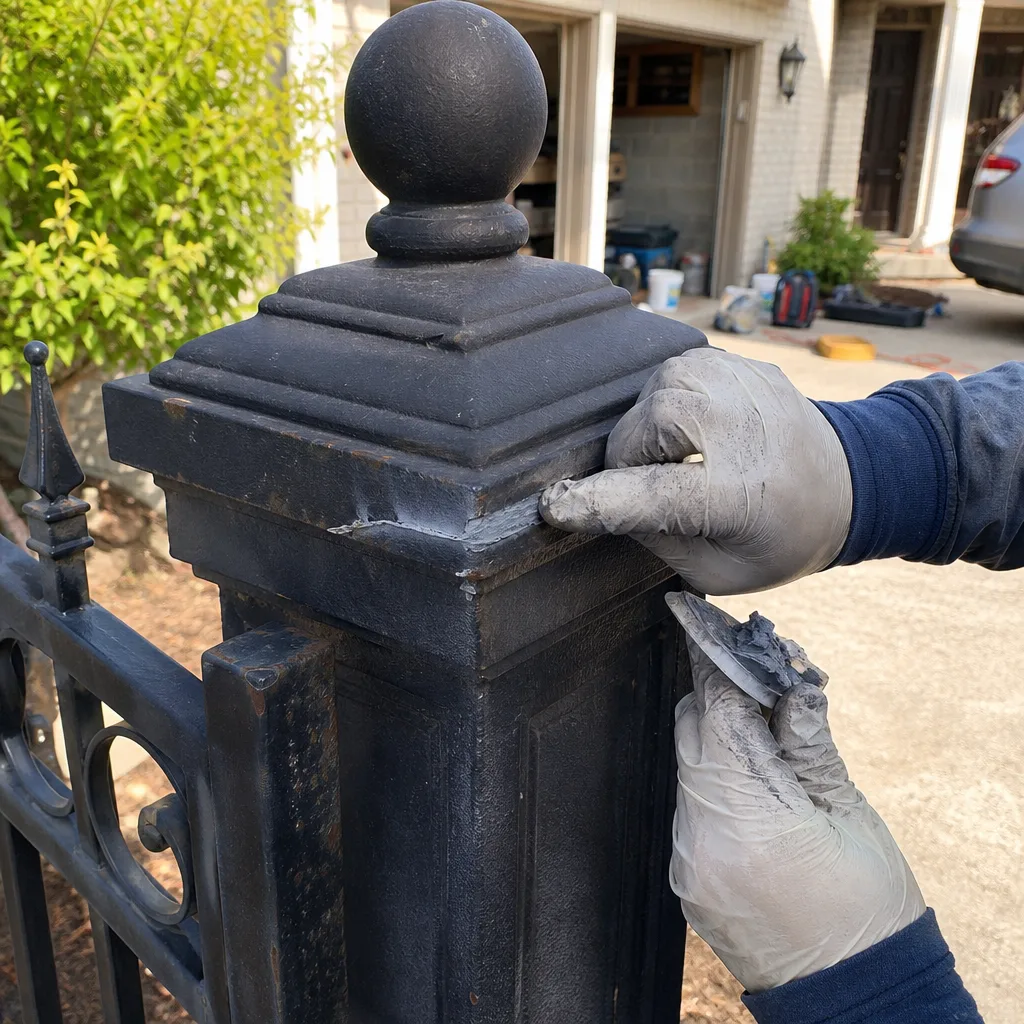
When Adrian Vance started in commercial access-control work in 2014, every job site required a wiring diagram before the system went live. That habit carried over into residential gate work, and it’s now the single best predictor of what a future repair will cost a Bedford homeowner. A gate installed without a wiring diagram is a guessing exercise for every technician who follows. A gate installed with a complete, accurate diagram can be diagnosed in a fraction of the time.
Here is what a diagram actually does for you:
- Identifies which wire runs to which terminal, eliminating continuity tracing on every call
- Shows the model number of the board, receiver, and transformer without opening every enclosure
- Records the original limit switch positions so drift can be measured against a baseline
- Marks the placement of junction boxes and splice points, including any underground conduit runs
- Includes the installer’s name and date, so future work can reference the original configuration
If your Bedford home has a gate and no diagram, you’ll pay for that missing documentation on the next service call. A technician has to trace every wire until he knows which one does what, and that time is billed. The good news: a diagram can be created retroactively. On any service visit to a Bedford home, we document the wiring, photograph the board, record the limit switch settings, and leave the homeowner with a printed record and a digital copy. From that point forward, every future repair starts from evidence rather than from discovery. The cost of that documentation is built into our service call; there’s no separate charge for the record.
If you’re comparing gate companies in Bedford, ask this question directly: “Do you leave a wiring diagram and photo record after the job?” The answer tells you whether a company is selling labor hours or building documentation. We know which one saves you money over the life of the gate.
Bedford-Specific Conditions: Corrosion, Caliche Soil, and Hinge Wear
Bedford sits on the Eastern Cross Timbers geological transition, and the soil here is not like the sandier ground of Fort Worth or the rocky limestone of Austin. It’s a dense, clay-heavy loam with scattered caliche deposits, and it moves. The soil swells when wet and contracts when dry, and over years, that slow flexing shifts gate posts, twists frames, and loads hinges unevenly. We see hinge wear in Bedford that accelerates faster than in other Texas metros because the soil movement is constant but small, and the forces accumulate without any single dramatic event.
What this means for your gate specifically:
- Post movement is the root cause of most hinge wear. A hinge that looked square at installation may be carrying lateral load five years later because the post has tilted two degrees
- Caliche layers complicate any new post installation. Digging through caliche in Bedford requires heavier equipment than standard post diggers, and some older gates sit on undersized footings because the original installer hit caliche and stopped short
- Summer heat bakes control boards. Bedford averages 97-plus-degree days for weeks every summer, and a control box mounted in direct sun on a west-facing wall can exceed 140 degrees internally, shortening capacitor and board life
- Spring storms drive horizontal rain into enclosures. North-facing enclosures on Bedford homes take water entry during spring frontal storms even when sealed, because the wind drives rain under gaskets
Hinge replacement in Bedford is a common repair precisely because of these soil conditions. A properly installed replacement, with the post checked for plumb before the new hinge is welded or bolted on, will last far longer than simply swapping the worn part in place. That’s the difference between treating the symptom and treating the root cause. When we replace hinges on a Bedford gate, we photograph the post angle, record it, and tell you if the post itself is moving. If it is, no hinge will hold indefinitely, and that’s information you deserve before you pay for the repair.
Repair or Replace? A Decision Tree for Gate Operators
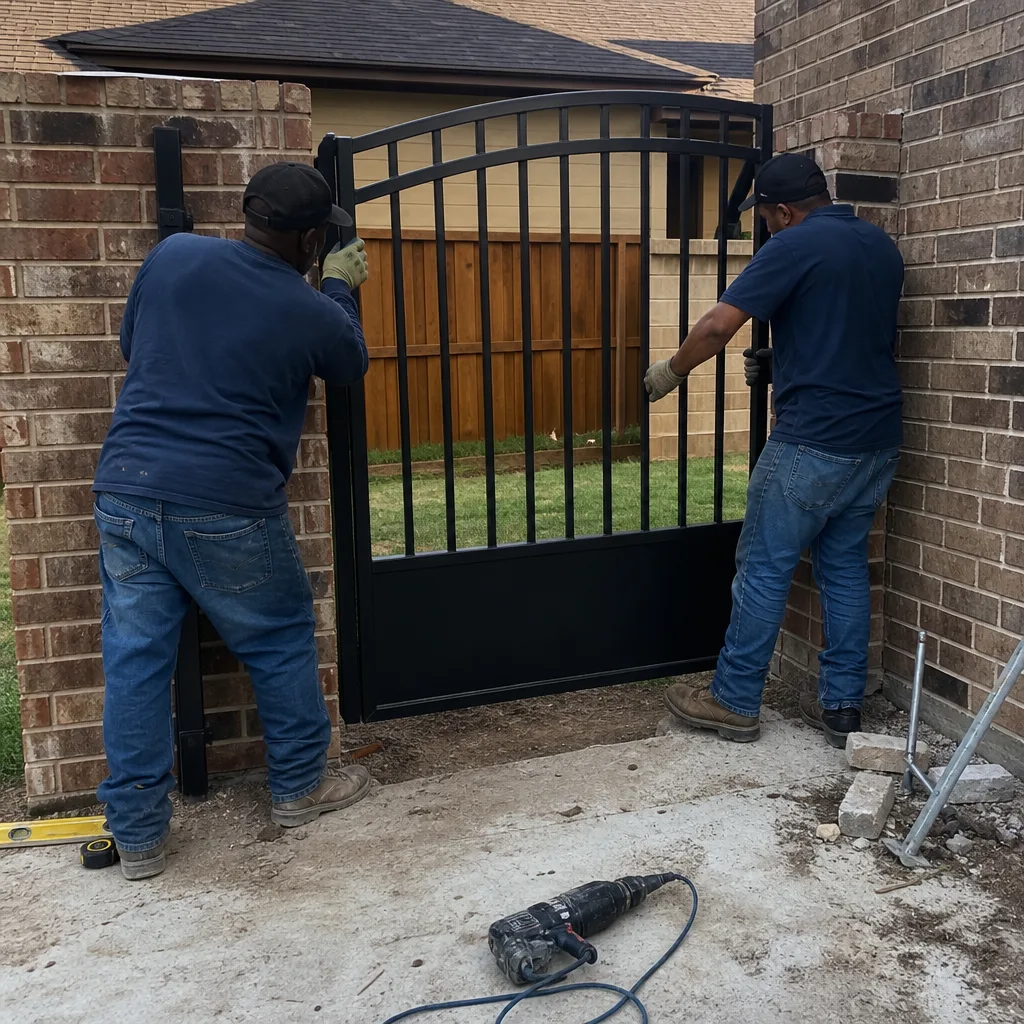
The question every Bedford homeowner eventually faces: put money into this operator or replace it? The answer is rarely about the age of the unit alone. A 12-year-old LiftMaster with a documented service history and clean board can outlast a four-year-old Mighty Mule that was overloaded every day. The decision should follow a sequence that weighs documented facts, not general impressions.
Walk through this decision tree in order:
- What does the failure history show? If this is the first significant repair ever, and the operator is under 10 years old, repair is almost always the right call. If the board has been replaced twice in three years, you are paying for a design or installation problem, not a wear item.
- What is the actual duty cycle? Count the cycles per day for a typical week. If the gate cycles more than 20 times daily and the operator is a residential unit, it’s been working beyond its design spec since day one. Replacement with a duty-rated operator is the only permanent fix.
- Is the board still available? Some residential brands discontinue parts after 7 to 10 years. If the board is no longer manufactured and used boards are the only option, that changes the math toward replacement.
- What’s the frame and hinge condition? If the gate structure is sound and alignment is within tolerance, a new operator will perform well. If the frame is sagging and the hinges are worn, no new operator will overcome the mechanical resistance, and you’ll be replacing the motor prematurely.
- What’s the breaker and wire gauge feeding the operator? A new operator on undersized wire will fail the same way the old one did. Any replacement in Bedford should verify the power supply is adequate for the new unit’s startup draw.
Replacement operator costs in Bedford, including installation and proper setup, typically land between $1,200 and $2,800 depending on brand, weight rating, and whether a battery backup is included. A board replacement runs $200 to $700. A limit switch adjustment is often under $180. The decision tree matters because these numbers differ by an order of magnitude.
For full context on what a new gate system involves, see our gate installation guide for Bedford. For operator-specific service details, revisit the gate motor and opener page.
Common Mistakes to Avoid
- Replacing the operator when the alignment is the problem. A gate that binds due to post movement will destroy a new motor the same way it strained the old one. Get the structure checked first, not after you’ve spent $2,000.
- Ignoring GFCI trips as “electrical gremlins.” In Bedford, repeated GFCI trips on a gate circuit after storms usually mean moisture entering a junction box or the operator enclosure. Resetting the breaker and moving on simply cycles the damage deeper.
- Paying for a new board before photographing the diagnostic LED pattern. Blinking codes identify the fault specifically. Without that photograph, you’re accepting a diagnosis from a tech who may be guessing, and you’re paying for a part that may not address the root cause.
- Letting the gate run with a failed photo-eye. The photo-eye is a safety device. Bypassing it or leaving it misaligned creates a real crush hazard for kids and pets. This is not a convenience fix; it’s a safety fix.
- Accepting a verbal quote with no written scope. A gate repair price quoted verbally, with no written line items or part numbers, leaves you exposed to an invoice that looks different from what was discussed. Insist on the paperwork before the work starts.
- Greasing the hinge without checking the post. Lubricant quiets a worn hinge temporarily, but if the post has shifted, the hinge is carrying load it was never designed for. The quiet returns because the wear surfaces were coated, not because the problem was corrected.
- Waiting for total failure before calling. A gate that’s slow, noisy, or intermittently unresponsive has already been failing for weeks in most Bedford homes. The repair at early-stage failure is smaller and cheaper than the repair at total failure, because secondary damage hasn’t accumulated yet.
When to Call a Professional
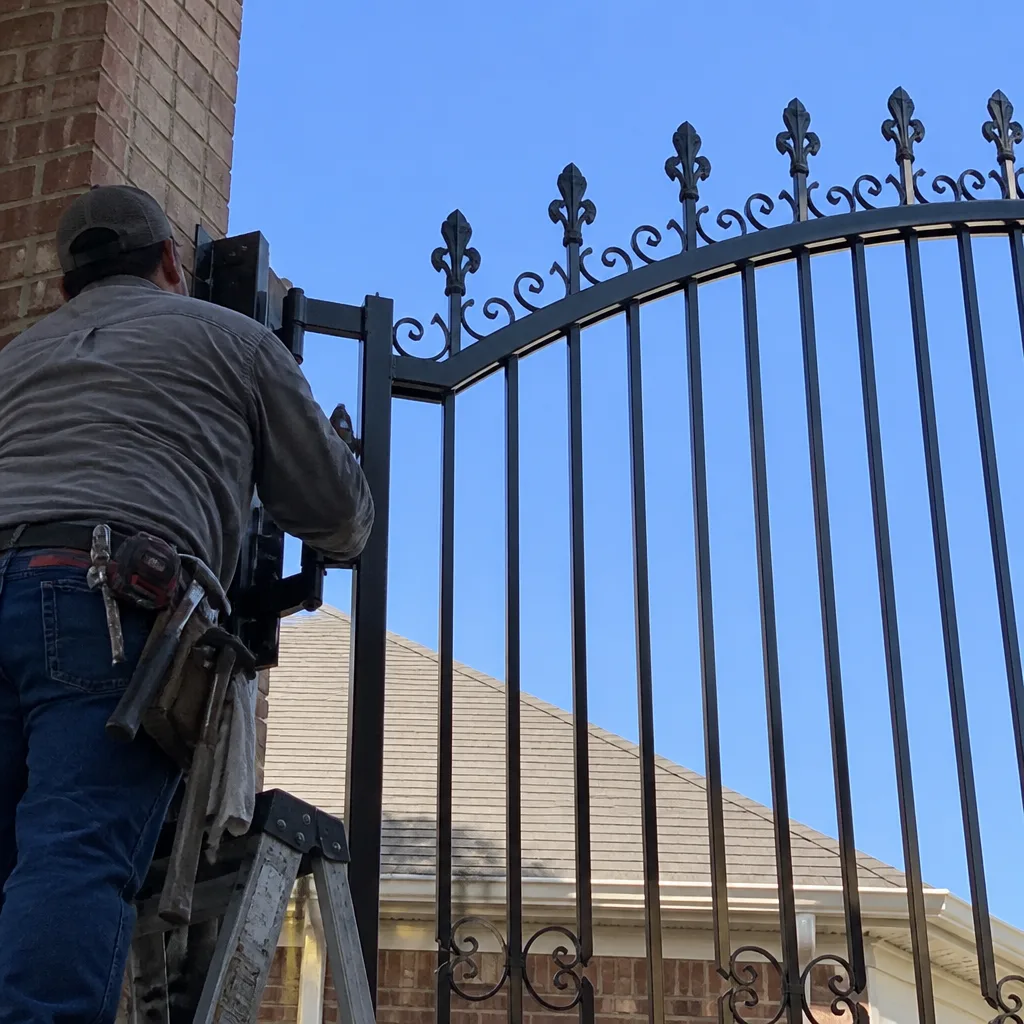
Some gate problems are safely diagnosed by a homeowner with the sequence above. Others require a trained hand: any repair involving high-tension springs on cantilever gates, any work inside an energized control panel, and any issue where the gate is a load-bearing structure. Gate operators and their components carry enough stored energy and electrical current to cause serious injury when mishandled. If the problem involves the spring assembly, the capacitor bank, or the gate’s structural welds, stop inspecting and call someone whose trade is gate work specifically. Vance Gate Repair Bedford offers free estimates in Bedford and the surrounding area. The technician arrives with the name and photo sent ahead, and the written price comes before any work begins. Call (817) 572-8590, any hour, and a person will answer.
For a full breakdown of service offerings and pricing philosophy, start with the Vance Gate Repair Bedford home page or the bedford gate repair service page.
Frequently Asked Questions
Most gate repairs in Bedford run between $145 and $580 depending on the part and the root cause. Common fixes like limit switch adjustment or photo-eye realignment fall at the low end; board replacement, hinge replacement, or actuator arm replacement run higher. Every quote from Vance Gate Repair Bedford is written and handed to you before work starts, so there is no surprise at the end. Call (817) 572-8590 for a free estimate.
Yes, in most cases. Bedford gate repairs that involve a simple adjustment, a photo-eye realignment, or a fuse or transformer replacement are regularly completed the same day, often on a single visit. Board replacements may require a parts order if the board isn’t stocked locally, but many boards for common brands in Bedford are available same-day from regional suppliers.
A full gate installation in Bedford includes the gate frame or panels, posts set below the frost line into the caliche-heavy soil, hinges, the operator and receiver, safety photo-eyes, the control box and transformer, and a complete wiring run from the power source. The finished job should include a wiring diagram and a documented record of settings. For details, see our full Bedford gate installation guide.
Yes. The power run from the panel or nearest sourced circuit is part of the installation scope on any Bedford job, and safety edges or photo-eyes are installed and tested before the job closes. The safety devices are not optional; a gate operator without functional safety sensors is not a completed installation.
We service nine major gate-automation brands including LiftMaster, FAAC, BFT, and Mighty Mule, along with Linear, Viking, Ghost Controls, DoorKing, and Elite. The service approach is the same regardless of brand: diagnose against evidence, document everything, and price in writing before work starts.
In most Bedford homes, a gate that reverses halfway has a limit switch that drifted out of position, a photo-eye that’s misaligned, or a resistance spike from hinge or track wear that the operator reads as an obstruction. It’s rarely the motor. The six-step trace sequence earlier in this guide will narrow it down before you call.
The Bottom Line
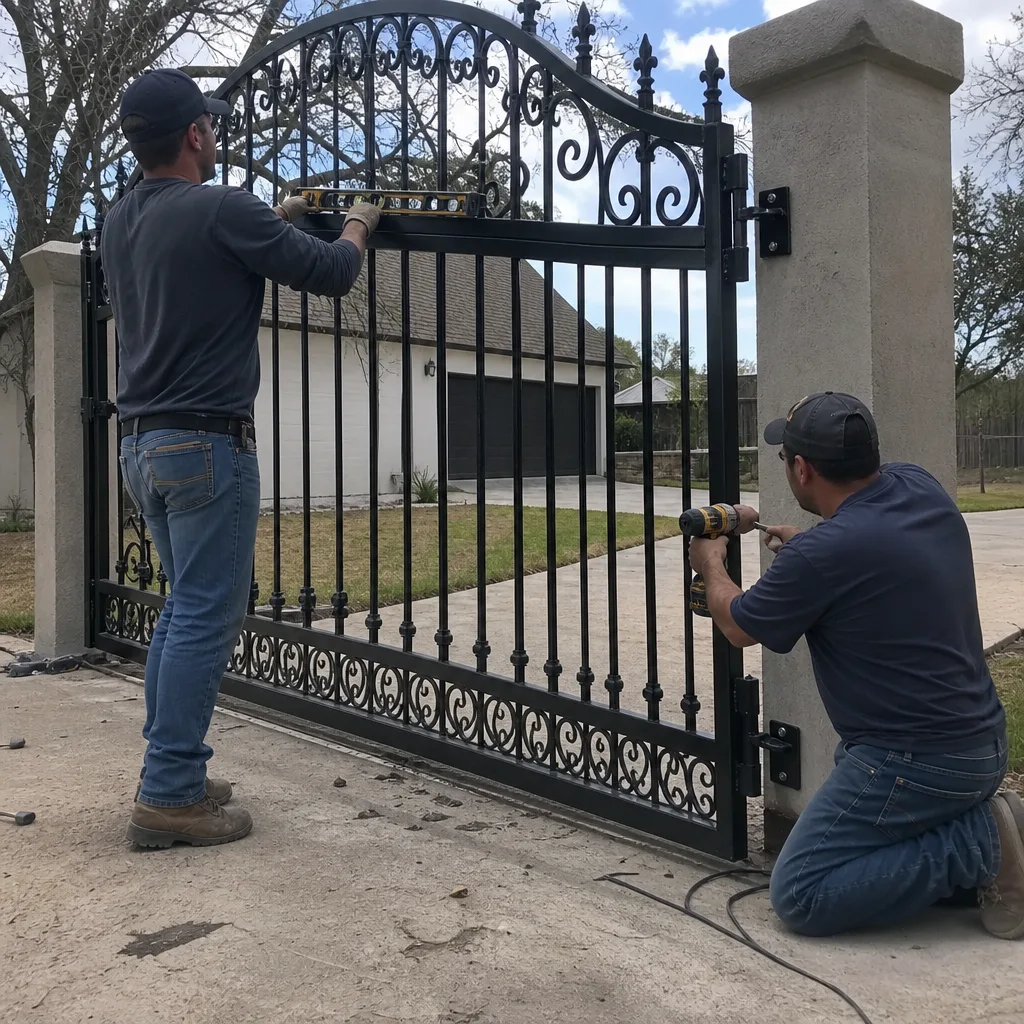
Bedford gate repair becomes predictable when you stop guessing at parts and start tracing symptoms. Alignment, power, and water: three root causes, each with a distinct signature, and each solvable for a known price when the diagnosis is based on evidence rather than assumption. The homeowners who pay the least over the life of a gate are the ones who demand documentation: a written scope, a written price, and a photo record of what was found and what was changed. That’s the Havens Standard, and it’s how every gate we touch in Bedford is treated. If your gate is misbehaving, start with the trace sequence. If you’d rather have trained eyes on it from the first minute, call (817) 572-8590. The price comes before the work, every time.
Written by Adrian Vance, Owner at Vance Gate Repair Bedford, serving Bedford since 2014.